

Small business eligibility is defined as meeting the size, ownership, and structural criteria set by the U.S. Small Business Administration and other government agencies to qualify for contracts, grants, and financing programs. Understanding what is small business eligibility matters because the rules vary by industry, program, and even the specific contract you are pursuing. The SBA uses NAICS codes to assign industry-specific thresholds, and your business must be independently owned, physically located in the United States, and not dominant in its field. Getting this right opens doors to set-aside contracts, SBA loan programs, and private financing options that are reserved for qualifying businesses.
What is small business eligibility and how does the SBA define it?
Small business eligibility is not a single universal standard. The SBA and IRS apply different definitions depending on the program, meaning a business can qualify for a government contract but not for a specific tax benefit. This distinction matters from day one.
The SBA’s definition centers on three core criteria: your business must be for-profit, independently owned and operated, and physically based in the United States. Beyond those basics, the SBA assigns size thresholds by industry using NAICS codes. Your NAICS code determines whether your size is measured by annual revenue or by employee count, and the limits differ significantly across sectors.

For most small business owners, the practical starting point is identifying your primary NAICS code and then checking the SBA’s published size standard for that code. A business earning the majority of its revenue from IT consulting, for example, should use an IT-sector NAICS code rather than a retail code. Misclassifying your NAICS code can make you appear ineligible when you actually qualify, or worse, create compliance problems down the line.

What are the size standards that determine eligibility?
SBA size standards vary widely by industry, measured by either annual revenue or employee count depending on the sector. Most non-manufacturing businesses have revenue thresholds ranging from $8 million to $47 million in annual receipts. Manufacturing businesses are measured by employee count, with thresholds reaching up to 1,500 employees.
Here is how thresholds break down across common industry categories:
- Retail trade: Generally capped at $8 million to $47 million in annual receipts, depending on the specific retail NAICS code.
- Professional services: Most codes fall in the $8 million to $20 million annual receipts range.
- Manufacturing: Measured by employee count, typically 500 to 1,500 employees depending on the product type.
- Construction: Measured by average annual receipts, with thresholds varying by type of construction work.
- Wholesale trade: Measured by employee count, typically capped at 100 to 250 employees.
Revenue is calculated as a five-year average of annual receipts. Employee count uses a 24-month average of all full-time, part-time, and temporary workers. Both methods are designed to smooth out short-term spikes that might otherwise push a business over the threshold in a single strong year.
Pro Tip: The SBA also offers an alternative size standard for businesses that exceed standard revenue or employee limits. To qualify under this alternative, your business must have a tangible net worth of no more than $20 million and average net income after taxes of no more than $6.5 million. This pathway is worth checking if your revenue is borderline.
One factor many business owners miss is the affiliation rule. Entities that can control your business, even if that control is never exercised, count as affiliates. Their revenue and employee counts are added to yours when calculating your size. A minority investor with board control, a parent company, or even a key customer with contractual authority over your operations can trigger affiliation. This rule catches businesses off guard more often than any other eligibility requirement.
| Industry category | Size measurement | Typical threshold |
|---|---|---|
| Retail trade | Annual receipts | $8M to $47M |
| Professional services | Annual receipts | $8M to $20M |
| Manufacturing | Employee count | 500 to 1,500 employees |
| Wholesale trade | Employee count | 100 to 250 employees |
| Construction | Annual receipts | Varies by work type |
What ownership and structural criteria affect eligibility?
Meeting a size threshold is necessary but not sufficient. Structural requirements enforced by the SBA can override eligibility even when your revenue and employee numbers are within limits. Three structural rules apply to every business seeking small business status.
First, your business must be independently owned and operated. This means no outside entity controls your day-to-day decisions or holds a dominant ownership stake that effectively removes your independence. Second, your business cannot be nationally dominant in its field. A company that controls a significant share of a national market does not qualify, regardless of its revenue figure. Third, your principal office must be physically located in the United States.
Beyond these baseline requirements, several specialized programs add their own eligibility layers:
- 8(a) Business Development Program: Requires at least 51% ownership by a U.S. citizen who is socially and economically disadvantaged. The owner’s personal net worth must be under $850,000, adjusted gross income must be $400,000 or less, and total assets cannot exceed $6.5 million.
- Women-Owned Small Business (WOSB): Requires at least 51% ownership and control by one or more women who are U.S. citizens.
- HUBZone Program: Requires the business to be located in a Historically Underutilized Business Zone and at least 35% of employees to live in a HUBZone.
- Service-Disabled Veteran-Owned Small Business (SDVOSB): Requires at least 51% ownership and control by a service-disabled veteran.
Pro Tip: If your business qualifies for more than one certification, apply for all of them. Holding multiple certifications increases your access to set-aside contracts across different government agencies and procurement categories.
Understanding the SBA loan eligibility criteria for your specific situation is worth doing before you apply for any program. The ownership rules for loan programs and contracting programs are similar but not identical.
How do you determine and prove your small business eligibility?
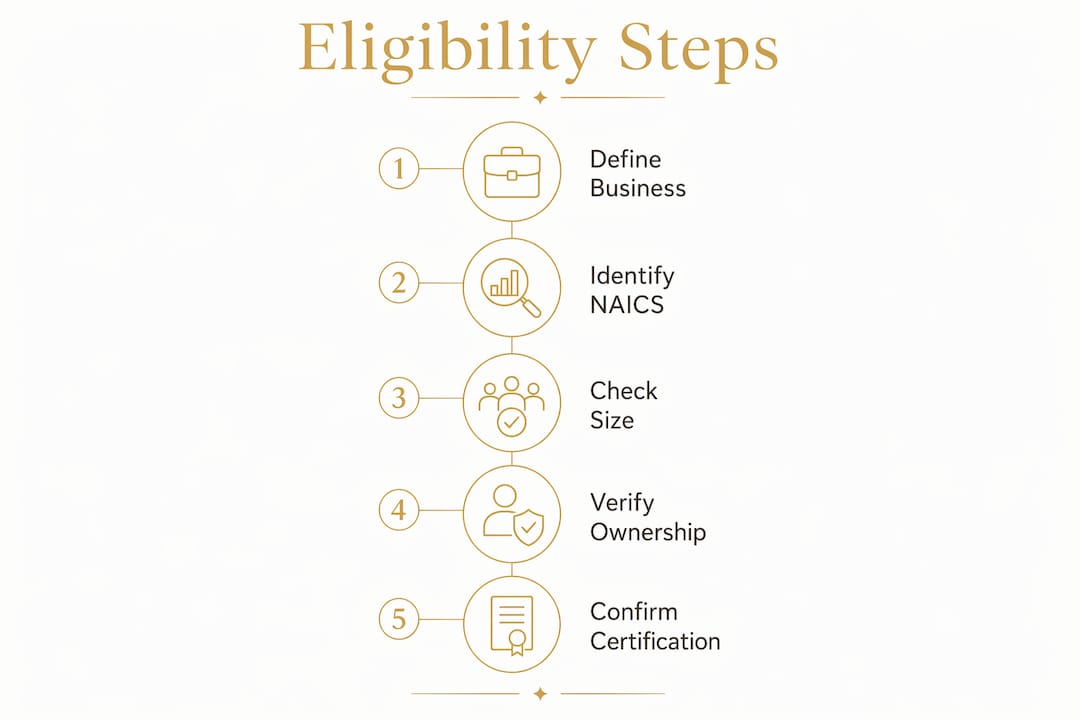
Proving your small business qualifications follows a clear process. Here are the steps that matter most:
- Register in SAM.gov. The System for Award Management is the federal database for government contractors. You must be registered and active in SAM.gov to receive any federal contract or grant. Registration must be renewed annually. Failure to renew disqualifies your business from new set-aside awards immediately.
- Select and validate your NAICS code. Use the SBA’s Size Standards Tool at sba.gov to confirm which size standard applies to your primary NAICS code. If your business operates across multiple industries, identify the code that matches your largest revenue source.
- Self-certify for general small business status. For most federal contracts, you self-certify your small business status when submitting a bid. No third-party verification is required for the general designation.
- Apply separately for specialized certifications. Programs like 8(a), HUBZone, and WOSB require a separate application through certify.sba.gov. Specialized certification can take weeks or months to process, so plan ahead before pursuing set-aside contracts in those categories.
- Gather and maintain supporting documentation. Tax returns, payroll records, contracts, and invoices are the primary documents used to verify revenue and employee counts. Keep three to five years of records organized and accessible.
- Renew annually. SAM.gov registration, and most specialized certifications, require annual renewal. Set calendar reminders at least 60 days before expiration.
Pro Tip: Many business owners assume that registering in SAM.gov is the same as being certified. It is not. SAM registration alone only makes you visible to federal buyers. Targeted programs require a separate, often lengthy application process through certify.sba.gov.
For small businesses pursuing financing rather than government contracts, the documentation process is similar. Lenders and grant programs use tax returns, bank statements, and cash flow records to verify that your business meets their specific small business eligibility requirements.
What happens when your business grows beyond eligibility thresholds?
Growth beyond SBA size standards does not immediately cancel your existing contracts. A business that exceeds thresholds can continue performing contracts awarded while it was still eligible. The restriction applies to new bids. Once your five-year revenue average or 24-month employee average crosses the threshold, you cannot bid on new small business set-aside contracts until your size comes back into range.
Key points to track as your business grows:
- Re-verification happens at each new bid. Your size is assessed at the time you submit a new offer, not at contract award. Use current averages, not last year’s numbers.
- Existing contracts are protected. You can fulfill and even receive option-year extensions on contracts awarded under your previous small business classification.
- Affiliation changes can trigger reclassification. Taking on a new investor, entering a joint venture, or signing a teaming agreement can change your affiliation status and push you over the threshold unexpectedly.
- Strategic planning matters. Some businesses approaching the threshold choose to restructure operations, delay certain revenue recognition, or pursue large-business contract vehicles before losing small business status entirely.
Reviewing your SBA loan options before crossing a size threshold is worth the time. Certain SBA loan programs have their own size criteria that differ from contracting standards, and qualifying for financing while you still meet the requirements gives you more capital flexibility during a growth phase.
Key Takeaways
Small business eligibility requires meeting SBA size standards by industry, maintaining independent ownership, holding a U.S. physical presence, and renewing certifications annually to keep access to contracts and financing programs.
| Point | Details |
|---|---|
| Size standards vary by industry | Revenue thresholds range from $8M to $47M; manufacturing uses employee counts up to 1,500. |
| NAICS code accuracy is critical | Your code determines your size threshold; misclassification creates compliance risk. |
| Affiliation rules add hidden size | Investors or partners with control over your business count toward your size calculation. |
| SAM.gov renewal is mandatory | Annual renewal is required; lapsed registration disqualifies you from new set-aside awards. |
| Growth protects existing contracts | Exceeding thresholds blocks new bids but does not cancel contracts already awarded. |
Why I think most businesses get eligibility wrong from the start
Most small business owners treat eligibility as a one-time checkbox. They register in SAM.gov, pick a NAICS code, and assume the work is done. That approach works until it does not, usually at the worst possible moment, right before a major contract bid or a financing application.
The part that trips people up most consistently is the affiliation rule. I have seen businesses lose eligibility not because they grew too large, but because a silent investor or a teaming partner had contractual control they never thought to disclose. The SBA counts that control whether or not it is ever used. Reviewing your ownership structure and any agreements that give outside parties authority over your business is not optional. It is the first thing you should do before self-certifying.
The second mistake is treating certification as a credential rather than a process. Certification requires annual renewals and ongoing record-keeping. A business that earned 8(a) status three years ago and has not maintained its documentation is not actually certified in any meaningful sense. The paperwork has to stay current.
My honest advice: pick your NAICS code carefully, review your affiliation exposure every year, and build a renewal calendar into your operations. If you qualify for multiple certifications, pursue them all. The businesses that use eligibility as a strategic asset rather than a compliance burden consistently outperform those that treat it as an afterthought.
— Jason
Financing built for businesses that qualify
Understanding your eligibility is the first step. Putting that status to work for your business is the next one.
Emorylending works with small businesses across industries to match them with financing that fits their actual situation. Whether you need working capital to cover payroll, equipment financing to expand capacity, or growth capital to take on larger contracts, Emorylending evaluates your business performance and cash flow rather than focusing narrowly on personal credit. Explore the full business financing options available to eligible small businesses, from $5,000 to $5,000,000 and beyond. Knowing your eligibility status puts you in a stronger position to secure the capital your business needs.
FAQ
What is the basic definition of small business eligibility?
Small business eligibility means your business meets the SBA’s size, ownership, and structural criteria for a specific program or contract. Requirements include being for-profit, independently owned, U.S.-based, and within the size threshold for your NAICS code.
How do NAICS codes affect small business qualifications?
Your NAICS code determines which SBA size standard applies to your business. Choosing the wrong code can misrepresent your eligibility, so always select the code that matches your primary revenue source.
Does SAM.gov registration count as small business certification?
SAM.gov registration makes your business visible to federal buyers but does not constitute certification. Specialized programs like 8(a) and HUBZone require a separate application through certify.sba.gov.
What happens to my contracts if I grow beyond the size threshold?
Existing contracts remain valid after you exceed the size threshold. You lose the ability to bid on new small business set-aside contracts until your five-year revenue average or 24-month employee average returns within the applicable limit.
Can a business qualify under multiple small business certifications?
Yes. A business can hold multiple certifications simultaneously, such as 8(a) and WOSB, if it meets the criteria for each. Holding multiple certifications expands access to set-aside contracts across different federal agencies and procurement programs.


