

Funding diversification is the practice of spreading your business’s financial backing across multiple capital sources to reduce dependency risk and expand growth capacity. Every business owner who relies on a single lender, investor, or revenue stream is one bad quarter away from a serious crisis. The answer to why diversify funding sources is straightforward: concentration kills flexibility. Research shows that organizations relying on one or two sources for over one-third of revenue face up to 40% higher financial crisis risk. Spreading capital across equity, debt, and revenue-based channels gives you negotiating power, resilience, and room to grow on your own terms.
Why diversify funding sources: the core benefits
The primary benefit of funding diversification is risk reduction. When one funding channel dries up, whether a bank tightens credit standards or an investor pulls back, a diversified portfolio keeps your operations running. That is not a theoretical advantage. Businesses with concentrated revenue streams exceeding 40% of total funding face measurably higher rates of operational disruption and staff cuts.
Diversification also improves your negotiating position. When you are not desperate for any single lender’s approval, you can compare terms, push back on rates, and walk away from bad deals. That leverage compounds over time.
The growth argument is equally strong. Diversified funding models provide what finance professionals call “optionality,” the ability to pursue new opportunities without waiting for one gatekeeper to say yes. A business with working capital financing, an equipment line, and a revenue-based advance can move faster than one waiting on a single bank approval.
The survival data is hard to ignore. Businesses and organizations that diversify proactively are 3x more likely to survive downturns than those with concentrated funding. That multiplier reflects the real cost of having no backup when your primary source fails.
- Risk reduction: No single source controls your fate
- Better terms: Competing lenders and investors sharpen their offers
- Growth speed: Multiple channels mean faster access to capital when opportunities arise
- Resilience: Downturns hit harder when you have nowhere else to turn
How do you measure and plan funding diversification?
Two frameworks give business owners a practical starting point. The first is the 33% Rule, which caps any single funding source at 33–40% of total revenue or capital. Once one source crosses that threshold, you are in concentration risk territory. The second is the 30/30/30/10 framework, which balances funding sources as follows: 30% from a primary source, 30% from a secondary source, 30% from community or earned revenue channels, and 10% held as reserves.

The 30/30/30/10 model is worth taking seriously. It prevents any single entity from gaining enough leverage to shift your priorities. Lenders, investors, and even major customers can impose conditions when they know you depend on them. Staying under the 30% threshold per source removes that pressure.
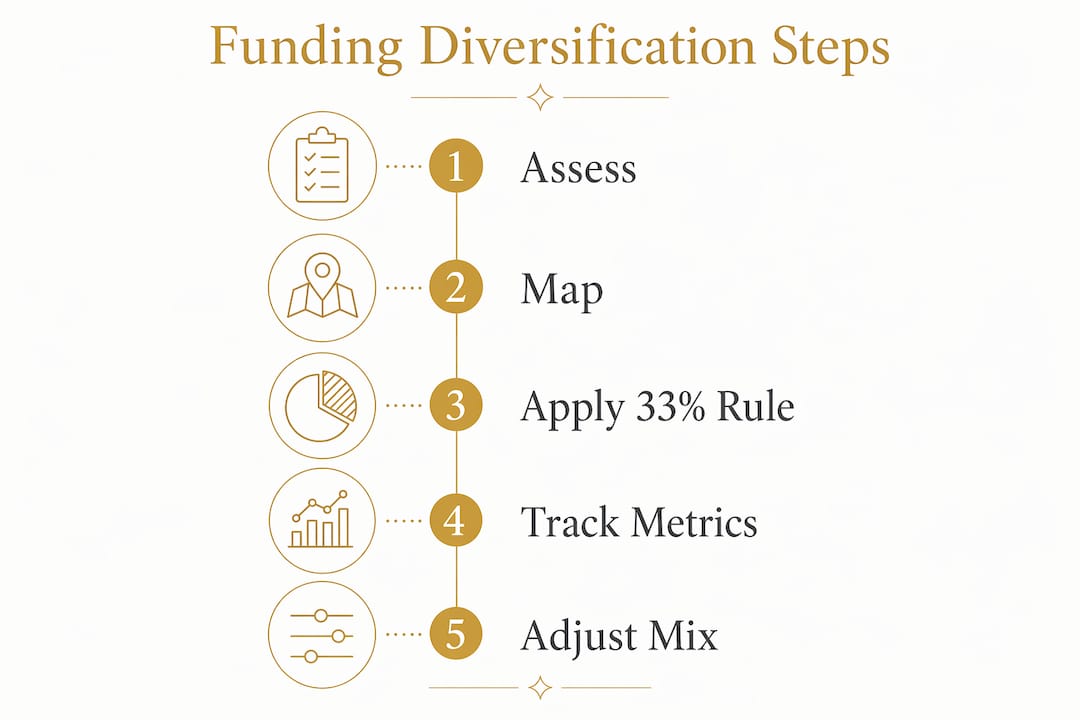
To apply these frameworks, start by mapping your current funding sources as percentages of total capital. Most business owners discover they are far more concentrated than they realized. A simple spreadsheet showing each source, its dollar amount, and its share of total funding is enough to identify the problem.
Pro Tip: Before adding a new funding source, calculate whether it moves your largest single source below 33%. If it does not, the new source is not solving your concentration risk. It is just adding complexity.
Metrics worth tracking include revenue source percentage by channel, the number of active funding relationships, and the average time to access capital from each source. The strategic flexibility you gain from this visibility is worth the effort of building the tracking system.
Comparing common funding sources: which ones belong in your mix?
No single funding type fits every business stage or goal. The table below summarizes the most common options and their strategic roles.
| Funding Source | Key Advantage | Main Trade-off | Best For |
|---|---|---|---|
| Bank term loans | Low cost of capital | Slow approval, credit-dependent | Established businesses with strong financials |
| Equipment financing | Preserves cash flow | Asset-specific use | Businesses buying machinery or vehicles |
| Working capital advances | Fast access, flexible use | Higher cost than term loans | Short-term gaps, payroll, inventory |
| Equity investment | No repayment required | Dilutes ownership and control | High-growth startups seeking scale |
| Revenue-based financing | Repayment tied to revenue | Can be expensive at scale | Businesses with predictable monthly revenue |
| Grants and partnerships | No repayment, no dilution | Competitive, often restricted | Businesses in targeted industries or regions |
Equity funding gives you capital without monthly payments, but you give up ownership and, often, decision-making authority. Debt financing preserves ownership but adds fixed obligations that can strain cash flow during slow periods. Revenue-based financing sits between the two: repayments flex with your income, but the total cost can exceed a traditional loan if revenue grows fast.
The strongest funding portfolios blend at least two or three of these types. A manufacturing company might combine equipment financing with a working capital line and a small equity stake from a strategic partner. That combination covers asset acquisition, day-to-day operations, and long-term growth without over-relying on any one channel.
Grants and corporate partnerships deserve more attention from business owners than they typically receive. They carry no repayment obligation and no ownership cost. The trade-off is time and eligibility requirements. For businesses in technology, manufacturing, or underserved markets, federal and state grant programs can meaningfully reduce capital costs.
What are the biggest mistakes in funding diversification?
The most common mistake is what researchers call the “funding trap.” Business owners add multiple funding sources without building systems to manage them, and the result is management challenges and instability rather than security. More sources do not automatically mean more stability. They mean more relationships, more compliance requirements, and more reporting obligations.
Over-extension is the second major pitfall. Trying to manage too many funding streams simultaneously leads to burnout and diluted focus. The practical solution is to build systems around 1–2 primary sources and treat secondary sources as supplements, not equals. Your primary sources should cover at least 60% of your capital needs with reliable, repeatable access.
Misunderstanding concentration risk is also common. Many owners assume that because they have three funding sources, they are diversified. If two of those sources come from the same lender or the same market segment, they carry correlated risk. A bank tightening credit standards affects all your bank-based products at once.
Pro Tip: Treat funding diversification as a 2–3 year project, not a quarterly task. Rapid diversification without building capacity first creates financial exposure during the transition period.
Finally, not all funding is worth taking. Accepting compliance-heavy grants or high-cost advances that do not align with your growth plan drains capacity without adding real value. Strategic refusal, the practice of declining misaligned funding, is a discipline that protects your focus and your margins.
How to diversify funding sources: practical steps
Building a diversified funding portfolio follows a clear sequence. Rushing any step creates the exposure you are trying to avoid.
- Audit your current funding. List every active source, its dollar amount, and its share of total capital. Identify any source above 33% immediately.
- Rank your sources by reliability. Some funding is predictable and renewable. Other sources are one-time or volatile. Know which is which before you add anything new.
- Identify one new source aligned with your business stage. A growing business with strong cash flow is a good candidate for a working capital advance or a revenue-based line. A capital-intensive business should look at equipment financing first.
- Build the relationship before you need the capital. Apply for a line of credit or establish a lender relationship during a strong period, not a desperate one. Terms are better and approval is faster when your financials are healthy.
- Set a 12-month milestone. Diversification is a multi-year process requiring intentional sequencing. Define what your funding mix should look like in 12 months and work backward from that target.
- Review and rebalance quarterly. Markets shift, lenders change terms, and your business evolves. A quarterly review of your funding portfolio keeps concentration risk in check and surfaces new opportunities.
Connecting your cash flow strategies to your funding mix is the final piece. Diversification works best when each funding source is matched to a specific use case, short-term gaps, long-term assets, or growth capital, rather than used interchangeably.
Key takeaways
Businesses that diversify funding sources across multiple channels are significantly more resilient, better positioned to grow, and far less vulnerable to single-source disruptions than those that rely on concentrated capital.
| Point | Details |
|---|---|
| Apply the 33% Rule | No single funding source should exceed 33–40% of your total capital to avoid concentration risk. |
| Use the 30/30/30/10 framework | Allocate 30% each to primary, secondary, and earned sources, with 10% in reserves for stability. |
| Blend funding types strategically | Mix debt, equity, and revenue-based sources to balance ownership, cost, and flexibility. |
| Avoid the funding trap | Adding sources without systems creates instability. Build around 1–2 core sources first. |
| Treat diversification as a multi-year plan | Sequence new sources over 2–3 years to avoid financial exposure during transition. |
The uncomfortable truth about funding diversification
Most business owners I talk to think about funding diversification the wrong way. They treat it as a safety net, something to build after things go wrong. The businesses that actually benefit from it treat it as a growth tool they build before they need it.
The hardest part is not finding new funding sources. It is saying no to the wrong ones. I have seen owners take on compliance-heavy grants or high-cost advances because the money was available, not because it fit their plan. That kind of opportunistic funding adds complexity without adding security.
The 33% Rule sounds simple until you realize most small businesses are running at 60–70% concentration with a single bank or lender. Getting below that threshold takes time and intentional effort. The businesses that do it over two or three years, methodically, end up with real negotiating power and real resilience.
My honest recommendation: start with your audit. Most owners are surprised by what they find. Once you see the concentration clearly, the path forward becomes obvious. You do not need ten funding sources. You need three good ones that do not all fail at the same time.
— Jason
Build your funding portfolio with Emorylending
Emorylending makes it straightforward to add multiple financing products to your capital stack without the friction of traditional bank lending. Whether you need a working capital line to cover operational gaps, equipment financing to fund asset purchases, or growth capital to expand locations, Emorylending evaluates your business performance and cash flow rather than personal credit scores.

That approach means more businesses qualify, and more businesses can build the kind of diversified funding portfolio that actually protects them. Explore the full business financing options available through Emorylending to find the right mix for your current stage and growth goals. Funding from $5,000 to $5,000,000+ is available across multiple product types, so you can build a real portfolio, not just a single loan.
FAQ
What is the 33% rule in funding diversification?
The 33% Rule caps any single funding source at 33–40% of total revenue or capital. Exceeding this threshold raises financial crisis risk by up to 40%.
How many funding sources should a small business have?
Most businesses benefit from 2–4 active funding sources. The goal is not volume but balance: each source should serve a distinct purpose and come from an independent channel.
What are the risks of relying on one funding source?
Single-source dependency creates operational vulnerability. Research shows that funding concentration above 40% correlates directly with higher rates of disruption and forced cost cuts.
How long does it take to diversify funding sources?
Effective diversification typically takes 2–3 years when done correctly. Rushing the process without building management capacity first creates financial exposure during the transition.
Does diversifying funding mean giving up ownership?
Not necessarily. Debt-based products like term loans, working capital advances, and equipment financing add capital without diluting equity. Balancing equity and debt sources preserves ownership while extending your financial runway.


