

Getting turned down by a bank because your business is too small or too young is one of the most frustrating moments an entrepreneur can face. You have a real opportunity, a real plan, and you just need capital to move. That’s exactly where a micro business loan comes in. These smaller, more accessible loans are designed specifically for business owners who don’t fit the traditional lending mold. This guide breaks down the micro loan definition, who qualifies, how the process works, and when this type of micro business funding makes more sense than the alternatives.
Table of Contents
- Key takeaways
- What is a micro business loan?
- How the SBA microloan program works
- Comparing micro loans to other small business financing
- How to qualify and make the most of a micro loan
- My honest take on micro business loans
- How Emorylending can help you find the right funding
- FAQ
Key takeaways
| Point | Details |
|---|---|
| Loan sizes are small but useful | SBA microloans go up to $50,000, with an average around $13,000, making them right-sized for early-stage needs. |
| Nonprofits handle the lending | You apply through SBA-approved intermediary lenders, not the SBA directly, and each sets its own terms. |
| Permitted uses are specific | Funds can cover working capital, inventory, equipment, and supplies, but not real estate or debt payoff. |
| Credit flexibility exists | A score around 620 is often preferred, but requirements vary by lender, so shopping around matters. |
| Mentorship is often included | Many intermediary lenders offer technical assistance that adds real business value beyond the loan itself. |
What is a micro business loan?
A micro business loan is a small, short-term loan designed for businesses that need modest capital and may not qualify for conventional bank financing. Think of it as a precision tool rather than a sledgehammer. You’re not borrowing $500,000 for a commercial property. You’re borrowing enough to stock inventory before your busy season, replace a piece of equipment that broke down, or cover payroll during a slow month.
The SBA microloan program is the most widely recognized version in the United States. SBA microloans offer up to $50,000 with average loans landing around $13,000 and interest rates ranging from 8% to 13%, with repayment terms of up to six or seven years. Those terms are genuinely reasonable for a business that doesn’t have years of financial history to show a traditional bank.
Who typically qualifies? Startups, sole proprietors, home-based businesses, and other small operations that have been underserved by conventional lenders. Microloans are often aimed at underserved entrepreneurs including minorities, women, veterans, and low-income individuals. If you’ve always assumed these programs weren’t for you, that assumption is probably wrong.
Here’s what SBA microloan funds can be used for:
- Working capital to cover day-to-day operational costs
- Inventory and supplies for your business
- Furniture and fixtures for a physical location
- Machinery and equipment purchases
And here’s what they cannot cover:
- Purchasing real estate
- Paying off existing business debts or refinancing loans
Pro Tip: Before you apply, write down exactly what the funds will be used for and confirm each line item falls within the permitted categories. One ineligible expense can derail an otherwise strong application.
How the SBA microloan program works
The structure of the SBA microloan program surprises most people who encounter it for the first time. The SBA does not lend money directly to your business. Instead, the application process is managed entirely by local SBA-approved nonprofit intermediary lenders, and those organizations receive the funds from the SBA and then distribute loans to qualifying small businesses.
This distinction matters because it changes how you approach the process. Here’s how the typical application unfolds:
- Find your local intermediary. Use the SBA’s lender locator to identify nonprofit intermediaries operating in your area. These are community-based organizations, often with deep ties to local business development ecosystems.
- Prepare your business plan and financials. Most lenders require a formal business plan, recent bank statements, profit and loss statements, and a detailed explanation of how you’ll use the funds.
- Submit your application. The nonprofit intermediary reviews your package, assesses risk, and makes a lending decision. Unlike a bank, they are often looking at the full picture of your business, not just your credit score.
- Complete any required training. Some intermediaries require borrowers to complete business training or participate in mentorship programs before or after receiving funds. This is actually one of the better features of the program.
- Receive funding. Approval typically takes a few weeks, and once approved, funds are disbursed by the intermediary.
A credit score around 620 is commonly preferred, though this varies. More importantly, collateral policies and interest rates vary widely among intermediary lenders, and rejection by one lender does not bar you from applying to others. If you get a no from one organization, move on and try another.
Pro Tip: Contact two or three intermediary lenders before submitting any application. Ask about their lending focus, typical borrower profile, and what they prioritize. This 30-minute conversation will tell you more than any website.

To understand how this fits within the broader world of business loan structures, it helps to read up on how different loan types are structured before committing to one path.
Comparing micro loans to other small business financing
Understanding micro business loan options means knowing where they fit relative to other funding types. Not every financing situation calls for a microloan, and not every business qualifies for the alternatives.
| Loan type | Amount range | Repayment term | Typical eligibility | Best for |
|---|---|---|---|---|
| SBA microloan | $500 to $50,000 | Up to 6 to 7 years | Startups, underserved borrowers | Small-scale capital needs |
| SBA 7(a) loan | Up to $5 million | Up to 25 years | Established businesses, strong credit | Larger growth or acquisition |
| Traditional bank loan | $50,000+ | Varies | Strong credit, collateral, history | Mature businesses |
| Business credit card | $1,000 to $50,000 | Revolving | Variable | Short-term purchases |
| Alternative lender | $5,000 to $500,000 | 3 months to 5 years | Revenue-based, flexible credit | Fast access, varied needs |
Compared to traditional loans, microloans feature easier qualification but come with smaller loan sizes and sometimes higher monthly payments because of shorter repayment periods. That tradeoff is worth it if what you need is $15,000 to buy a commercial oven or a delivery vehicle, and you’d never qualify for a $100,000 bank loan.
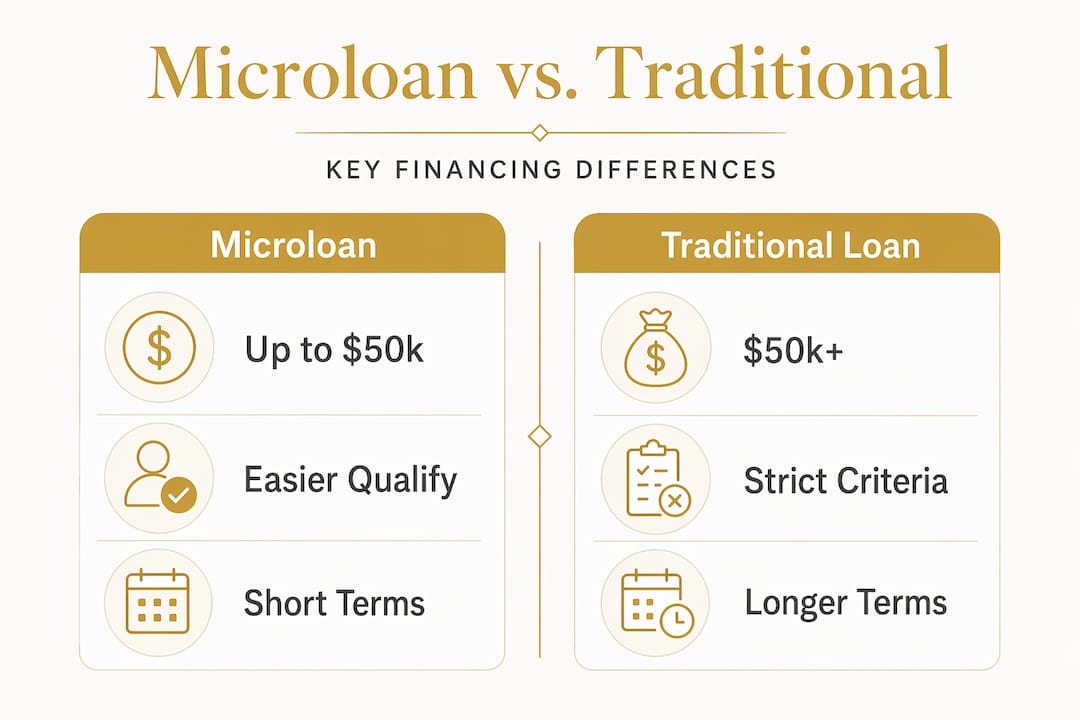
Where microloans fall short is when your capital need exceeds $50,000 or when you need rapid deployment of funds. They also can’t help if your intended use involves paying off debt or purchasing property. For those situations, reviewing your business loan eligibility and exploring SBA 7(a) or alternative lenders becomes the smarter move.
The scenario where a microloan wins every time: a first-time business owner with limited credit history who needs $10,000 to $25,000 for a specific, permitted purpose and values the mentoring component that comes along with it.
How to qualify and make the most of a micro loan
Getting approved is one thing. Getting the most out of your loan is another. Here’s what actually moves the needle when you’re preparing to apply and execute.
Build a budget before you write a business plan. Most business owners do it backward. They write a narrative and tack on numbers at the end. Lenders care deeply about the numbers. Know exactly how much you need, what each dollar will be spent on, and how that spending connects to revenue growth or cost reduction.
Get your financial documents in order early. Intermediary lenders will want to see bank statements, tax returns, and sometimes a balance sheet. If your records are scattered across three apps and a shoebox, that creates doubt. Organized financials signal a well-run business.
Align your request with permitted uses. This seems obvious, but ineligible uses such as paying off existing debts or purchasing real estate lead to automatic rejection regardless of your credit profile. Double-check every line item against the approved use list before submitting.
Here are smart uses that work well with microloan amounts:
- Buying inventory ahead of a seasonal peak
- Purchasing one critical piece of equipment that directly generates revenue
- Adding a few months of working capital buffer to stabilize cash flow
- Covering supply costs for a new contract you’ve already landed
The mentorship programs attached to many microloan intermediaries are genuinely underutilized. Programs include technical assistance and mentoring designed to support borrower success. Treat that as a real resource, not a box to check. Many business owners have walked away from the mentoring program with connections and guidance worth more than the loan itself.
Pro Tip: Ask your intermediary lender specifically what the mentorship covers before you accept funds. Some programs offer bookkeeping help, marketing coaching, and access to business networks. That’s free advisory support you’d otherwise pay for.
To see examples of how businesses have put small loans to smart use, the smart ways to use business loans resource from Emorylending breaks down real funding scenarios worth reviewing.
My honest take on micro business loans
I’ve seen a lot of business owners dismiss microloans because the amounts feel too small. They hear “$13,000 average” and immediately think it won’t solve their problem. What I’ve found is that this reaction usually reflects a mismatch between what they want and what they actually need right now.
In my experience, the biggest mistake is confusing the size of your ambition with the size of funding you need in this moment. A $15,000 microloan used precisely, for the right equipment or inventory, can generate enough cash flow to make you eligible for a $100,000 loan eighteen months later. It’s a stepping stone, and treating it as one changes how you use it.
What I’ve also learned is that the intermediary lender you choose matters more than most applicants realize. Entrepreneurs succeed most when they identify intermediary lenders whose criteria and assistance programs actually match their business profile. I’ve watched people get rejected by one lender and approved by another within weeks, simply because the second lender had a different focus area that aligned better with their industry.
The patience piece is real too. A few weeks feels like forever when you need money to operate. Build that timeline into your planning. Apply before you’re desperate, not after. That single shift in timing removes most of the stress from the process and gives you negotiating room.
— Jason
How Emorylending can help you find the right funding
At Emorylending, we know that micro business funding is often just the starting point. Whether you’re looking at an SBA microloan or need something larger to cover equipment, expansion, or working capital, we evaluate your business performance and cash flow, not just your credit score. That means more small business owners qualify for funding that actually fits their situation.
If you’re buying equipment and a microloan covers only part of the cost, our equipment financing guide walks you through how to structure the rest. If cash flow is the core issue, explore our working capital solutions built specifically for small businesses navigating gaps between revenue and expenses. We fund from $5,000 to $5,000,000+, and our team is ready to match you with the right product for your stage of growth.
FAQ
What is a micro business loan in simple terms?
A micro business loan is a small loan, typically under $50,000, designed for startups and small businesses that don’t qualify for traditional bank financing. The most common version in the U.S. is the SBA microloan, offered through nonprofit intermediary lenders.
What qualifies for a micro loan?
Most for-profit small businesses and certain nonprofit childcare centers qualify, with a preferred credit score around 620. Startups, sole proprietors, and underserved entrepreneurs are the primary audience for these programs.
How do you get a micro loan?
You apply through a local SBA-approved nonprofit intermediary lender, not the SBA directly. The process involves submitting a business plan, financial documents, and an explanation of intended fund use, with approval typically taking a few weeks.
What are the requirements for micro loans?
Requirements vary by intermediary lender but generally include a business plan, financial statements, a credit review, and a clear description of how funds will be used. Collateral and a personal guarantee may also be required depending on the lender.
Can micro loan funds be used for anything?
No. SBA microloan funds are restricted to working capital, inventory, supplies, furniture, fixtures, machinery, and equipment. They cannot be used to purchase real estate or pay off existing business debts.


