

Most business owners don’t have the luxury of waiting six to eight weeks for a bank to make a decision. When payroll is due Friday, a supplier is offering a limited bulk discount, or a piece of equipment breaks down without warning, you need capital now. That’s exactly why choose fast business funding has become one of the most searched topics among small business owners in 2026. Fast funding isn’t just a convenience. For many businesses, it’s the difference between seizing an opportunity and watching it disappear. This article breaks down how it works, what it costs, and how to choose it wisely.
Table of Contents
- Key takeaways
- Why choose fast business funding
- The real benefits of quick business loans
- What to watch out for with fast funding options
- How to choose the right fast funding for your business
- Real situations where fast business funding delivered
- My honest take on speed versus strategy
- How Emorylending can help you fund faster
- FAQ
Key takeaways
| Point | Details |
|---|---|
| Speed is the primary advantage | Fast business funding can deliver capital within 24 to 48 hours, sometimes the same day. |
| Multiple fast funding types exist | Short-term loans, lines of credit, merchant cash advances, and revenue-based financing each serve different needs. |
| Cost is the key trade-off | Faster loans typically carry higher APRs, so comparing total repayment matters as much as approval speed. |
| Match repayment to cash flow | Aligning loan terms with your revenue cycle prevents cash crunches and operational strain. |
| Accessibility is broader | Online lenders often approve businesses with credit scores as low as 600, opening doors traditional banks close. |
Why choose fast business funding
Traditional bank loans are built for a different era. The application process often takes weeks, requires extensive documentation, and favors businesses with long track records and near-perfect credit. Meanwhile, your business operates in real time.
Fast business funding solves that gap. Same-day funding is available from certain online lenders, with some offering up to $600,000 and accessible terms even for lower credit scores. These lenders use digital tools to verify income, assess cash flow, and make decisions in hours rather than weeks.
The most common fast business financing options include:
- Short-term loans: Lump-sum capital repaid over three to eighteen months. Good for one-time, defined expenses.
- Business lines of credit: Revolving access to funds you draw as needed. You only pay interest on what you use.
- Merchant cash advances (MCAs): An advance against future credit card sales, repaid as a percentage of daily revenue.
- Revenue-based financing (RBF): Repayments flex with your monthly revenue, making this well-suited for seasonal businesses.
- Bridge loans: Short-term funding designed to cover a gap until longer-term financing is secured.
Qualification standards are notably lighter than traditional lenders. Online lenders approve loans with minimum credit scores as low as 600 and short operational histories, which makes them a real option for startups and businesses that traditional banks would turn away.
Pro Tip: Before applying, pull three to six months of your bank statements and organize your revenue data. Most fast lenders will ask for exactly this, and having it ready cuts your approval time in half.
The real benefits of quick business loans
The advantages of rapid funding go beyond just getting money fast. They reshape how you operate and compete.

Speed that matches business reality. Emergencies and opportunities don’t schedule themselves. Online business lending delivers quick cash with streamlined applications and minimal documentation, sometimes within the same business day. That speed is not just convenient. It keeps your business moving when timing is everything.
Flexibility in how you use the funds. Unlike SBA loans or equipment-specific financing, most fast funding products place no restrictions on how you spend the capital. You can cover payroll one month and purchase inventory the next. This flexibility is a genuine competitive edge for small business owners navigating unpredictable markets.
Accessibility for businesses that don’t fit the traditional mold. Many business owners believe their credit score disqualifies them from funding. That’s rarely true with fast business financing options. Alternative lenders evaluate your actual business performance, including revenue trends and cash flow, rather than leaning entirely on personal credit history. This opens access to capital for newer businesses, seasonal operators, and entrepreneurs who have had past credit challenges.
Continuity during slow periods. Cash flow gaps are not signs of a failing business. They’re a normal part of operating in cycles. Quick funding for entrepreneurs provides the buffer to pay suppliers, keep staff on payroll, and maintain operations during the valleys between revenue peaks.
Here’s a number worth considering: the vast majority of small business owners report that cash flow problems are their top operational concern. Fast capital for startups and growing businesses directly addresses that concern by shrinking the time between “we need money” and “we have money.”
Pro Tip: If you’re using fast funding to manage cash flow cycles, track the exact days your receivables typically arrive versus when major expenses hit. That gap is your real funding need, and knowing it precisely helps you borrow only what you need.
What to watch out for with fast funding options
No funding product is perfect. The faster the money, generally the higher the cost. That’s not a reason to avoid fast business financing, but it is a reason to go in with clear eyes.
Bridge financing options help cover temporary cash flow gaps but can be costly and cash-flow intensive if misused. Factor rates on merchant cash advances, for example, can translate to effective APRs well above what a traditional loan would carry. If you only look at the lump-sum advance and the daily repayment amount, you may miss the true cost.
Key risks to keep in mind:
- High effective APR: Factor rates and short terms can push the annualized cost of borrowing significantly higher than bank loan rates.
- Short repayment windows: Weekly or daily repayments work when revenue is steady, but fixed daily payments can drain cash if your revenue cycles are longer than your repayment schedule.
- Rollover traps: Some business owners repeatedly renew short-term loans without addressing the underlying cash flow issue, creating a cycle of debt that compounds costs.
- Limited long-term value: If you need financing for five to ten years to fund a major expansion, fast funding products are not built for that purpose.
“Faster funding does not guarantee the lowest cost. Business owners must assess total cost including fees, not just approval speed.” Source: Bridge Financing Companies, 2026
The SBA 7(a) program offers lower rates and longer terms but requires extensive approval time and documentation. Many smart business owners use fast funding as a bridge, then refinance later with lower-cost, longer-term products once stability is established. That two-step strategy is legitimate and often the right call.
How to choose the right fast funding for your business
Choosing correctly starts with one question: what does your cash flow actually look like?
If your business collects revenue daily or weekly, like a restaurant or retail store, a merchant cash advance with daily repayments may fit naturally. If you bill clients on net-30 or net-60 terms, you want a product with monthly repayments or a line of credit you can draw and repay as invoices clear.
Revenue-based financing aligns repayments with your business income, so payments drop automatically during slow months. That’s a meaningful protection for seasonal businesses compared to fixed-payment alternatives.
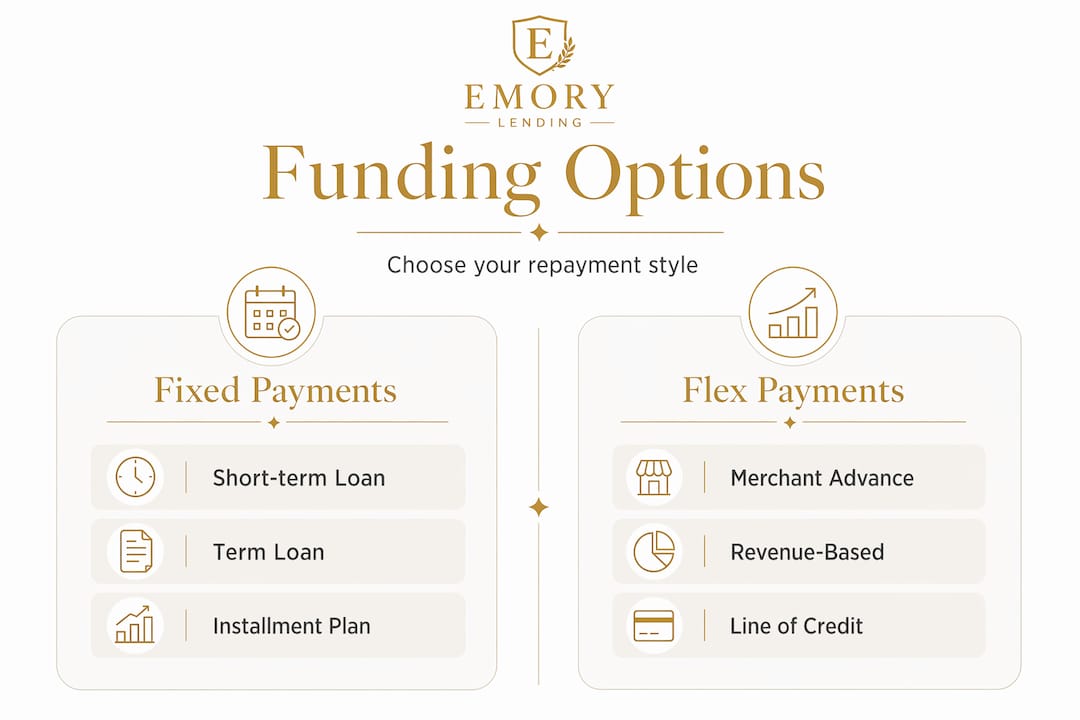
Use this comparison framework when evaluating your options:
| Funding type | Best for | Repayment style | Typical speed |
|---|---|---|---|
| Short-term loan | One-time expenses | Fixed monthly | 24 to 72 hours |
| Business line of credit | Ongoing cash flow gaps | Flexible draws | 1 to 3 days |
| Merchant cash advance | High card-sales volume | % of daily revenue | Same day |
| Revenue-based financing | Seasonal businesses | % of monthly revenue | 2 to 5 days |
| Bridge loan | Gap before long-term financing | Balloon or monthly | 24 to 48 hours |
Beyond repayment structure, evaluate lender transparency. A trustworthy fast lender will show you the total repayment amount, all fees, and the effective cost of the loan before you sign. If a lender makes it hard to find those numbers, that’s a signal to look elsewhere. Use the business funding checklist developed for making fast, confident decisions to make sure you’re asking the right questions before committing.
Understanding business loan eligibility requirements ahead of time also reduces friction and speeds up the process with whichever lender you choose.
Pro Tip: Calculate the total dollar cost of the loan, not just the interest rate or factor rate. Divide that total cost by the amount borrowed and then by the loan term in months to get a true monthly cost of capital. That number makes it easy to compare any two products side by side.
Real situations where fast business funding delivered
Fast funding is not theoretical. It shows up in specific, practical moments that determine whether a business thrives or scrambles.
-
Urgent inventory before peak season. A retail business owner learns their top-selling product supplier is offering a 20% discount for orders placed before a peak demand window. They don’t have the cash on hand. A short-term loan approved in 48 hours lets them place the order, and the increased margin from the discount more than covers the loan cost.
-
Bridging a payroll gap. A construction company finishes a major project but the client’s payment is delayed by 30 days. Payroll can’t wait. A business line of credit covers the gap, is repaid when the invoice clears, and the team stays whole.
-
Seizing a growth opportunity. A service business gets an unexpected referral for a contract three times the size of its usual work. Taking it requires hiring two additional people and purchasing equipment. A fast capital decision enables them to say yes instead of turning down the contract.
-
Managing delayed receivables. A B2B supplier routinely waits 45 to 60 days for payment. Rather than letting that gap restrict purchasing and operations, they use invoice factoring or a revolving credit line to maintain momentum.
-
Avoiding a cash crunch after a slow month. Revenue drops unexpectedly due to weather, a local event, or seasonal demand shifts. Revenue-based financing with flexible repayments absorbs the dip without forcing the owner to choose between paying bills or paying staff.
Each scenario shares one trait: the ability to access fast funding solutions quickly meant the business owner controlled the outcome rather than reacting to it.
My honest take on speed versus strategy
I’ve worked with a lot of business owners who come to fast funding in a panic. And I understand it. When things get tight, the instinct is to find money as fast as possible. But I’ve seen that urgency lead to bad decisions more times than I can count.
The most common mistake is treating speed as the only filter. Owners compare two lenders on how fast funds arrive, not on what the total repayment looks like three months in. Then they’re surprised when daily withdrawals start putting pressure on operating accounts.
What I’ve found actually works is this: know your cash conversion cycle before you ever start an application. How long does it take from spending money to collecting it? That number tells you what loan term you can realistically handle and whether a fixed or flexible repayment product fits your situation.
Fast business funding is a legitimate, powerful tool. But it’s a tool, not a rescue plan. The owners I’ve seen use it well treat it the same way they treat any business decision. They know the cost, they know the repayment, and they know exactly what result they expect from deploying the capital. That kind of clarity turns a fast loan into a growth lever instead of a financial burden.
— Jason
How Emorylending can help you fund faster
At Emorylending, fast business financing isn’t a marketing claim. It’s how the operation works. Emorylending evaluates your business performance and cash flow rather than relying on personal credit scores, which means more small businesses actually get approved. Whether you need working capital to cover a slow period, funds to purchase equipment, or capital to expand a location, Emorylending offers funding from $5,000 to $5,000,000 with an application process built for speed and clarity.
The business financing options available through Emorylending cover the full range of what growing businesses actually need. The process is straightforward, transparent, and designed for business owners who don’t have weeks to spare. If you’re ready to find the right fast funding product for your business, Emorylending is a practical place to start.
FAQ
What is fast business funding?
Fast business funding refers to financing products that deliver capital to a business within 24 to 72 hours, typically through online or alternative lenders using digital verification and automated approvals rather than traditional bank review processes.
Why choose fast business funding over a bank loan?
Bank loans are better for long-term, low-cost financing but take weeks to approve. Fast business funding is the better choice when you need capital quickly to cover payroll, inventory, or an unexpected expense and can’t afford to wait.
What credit score do you need for fast business funding?
Online lenders commonly approve applicants with credit scores as low as 600, making fast funding accessible to businesses that would not qualify for traditional bank financing.
What are the main drawbacks of fast business loans?
The primary drawback is cost. Fast business loans typically carry higher APRs and factor rates than traditional loans, and short repayment terms can strain cash flow if the loan isn’t matched carefully to your revenue cycle.
How do I choose the right fast funding product?
Start with your cash flow cycle. Match repayment frequency and loan term to when your revenue actually arrives, then compare the total dollar cost across at least two or three lenders before signing anything.


