

Seasonal business financing is defined as funding structured to align capital availability with a business’s predictable revenue cycles, covering expenses during slow periods and fueling growth before peak demand. If you run a landscaping company, a beach resort, a holiday retail shop, or a ski rental operation, your cash needs do not follow a straight line. The SBA’s CAPLines program and a range of private lenders have built products specifically for this pattern. Understanding what is seasonal business financing, how it works, and when to apply gives you a real advantage over owners who scramble for cash at the worst possible moment.
What is seasonal business financing and how does it work?
Seasonal business financing provides working capital timed to peak and off-peak months, covering inventory, payroll, and operating costs. The core mechanic is simple: you draw funds before or during a slow period, then repay when revenue returns. That alignment between draw schedules and repayment windows is what separates seasonal financing from a standard term loan, which demands fixed monthly payments regardless of what your bank account looks like.
Think of a North Carolina mountain resort that earns most of its revenue between june and august. The owner needs to hire staff, stock supplies, and repair equipment in april and may, before a single dollar of peak revenue arrives. A seasonal loan or line of credit covers that gap. Repayment kicks in once summer bookings fill the register.

This type of funding is also called seasonal working capital financing in formal lender documents. Both terms refer to the same concept, so you will see them used interchangeably by banks, the SBA, and alternative lenders.
Common uses for seasonal financing
Seasonal financing covers a wide range of operational needs during revenue troughs:
- Inventory purchases before a peak selling season
- Payroll for seasonal staff hired ahead of demand
- Rent and utilities during months with little to no revenue
- Marketing spend to drive bookings or foot traffic before peak periods
- Equipment repairs or upgrades needed before the busy season opens
Pro Tip: Apply for seasonal financing during or just after your peak revenue period, not after the slow season has already started. Lenders prefer recent strong revenue months when evaluating your application, and your approval odds drop sharply once cash reserves are already thin.
What are the typical eligibility requirements for seasonal financing?
Lenders evaluate seasonal businesses differently than they evaluate year-round operations. A single slow month does not disqualify you. What matters is your overall annual pattern.
The standard eligibility criteria most lenders apply are:
- Operating history: At least 1 year in business, with documented seasonal revenue cycles.
- Credit score: A minimum of 550–600+ personal credit score is common across most lenders.
- Annual revenue: Most lenders set a floor of $100,000–$120,000 in annual revenue, not monthly.
- Revenue pattern documentation: Bank statements, tax returns, and point-of-sale records that show consistent seasonal peaks and troughs.
- Business structure: A registered LLC, S-Corp, or sole proprietorship with a business bank account.
The third point catches many owners off guard. Lenders look at your full-year revenue, not the three slow months you are trying to survive. That means a business earning $200,000 in five months and nearly nothing in seven months still qualifies, provided the annual total clears the threshold. This is a key reason why assessing your business cash flow accurately before applying matters so much.
NC seasonal business financing markets, including Asheville and the Outer Banks, follow these same national standards. VA seasonal business financing applicants face identical criteria from most regional and national lenders.
Pro Tip: Prepare a written revenue forecast showing your peak-to-trough cycle before any lender meeting. A clear forecast demonstrates that your slow months are predictable, not a sign of distress, and it significantly improves lender confidence.
What financing options work best for seasonal businesses?
Three products dominate the seasonal financing market. Each fits a different cash flow profile, so matching the product to your cycle matters more than chasing the lowest rate.
Business lines of credit
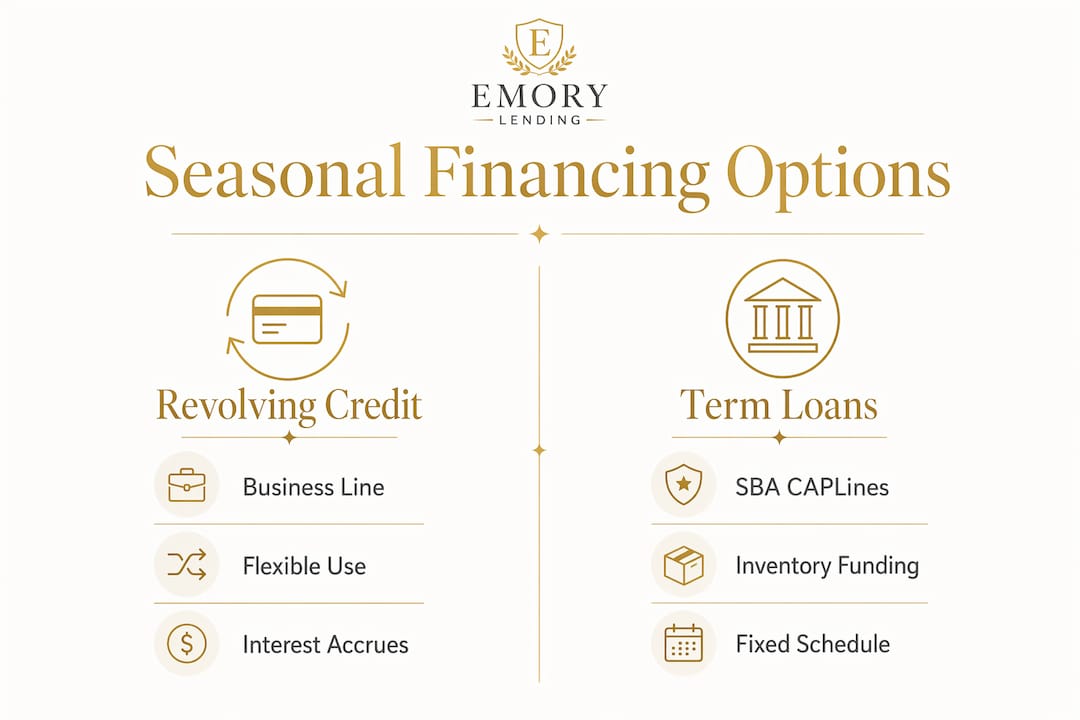
A business line of credit is the most flexible short-term financing option for seasonal businesses. Interest accrues only on the drawn amount, which means you pay nothing on funds you have not used. You draw when you need cash, repay during peak revenue months, and the credit resets for the next cycle. This revolving structure makes it the best financing for seasonal sales patterns that repeat year after year.
SBA Seasonal CAPLines
The SBA’s Seasonal CAPLine program finances seasonal increases in accounts receivable, inventory, and labor costs. It comes in both revolving and non-revolving structures. The revolving version works like a line of credit. The non-revolving version delivers a lump sum you repay over a set term. CAPLines are government-backed, which means lower rates, but the application process takes longer than most private lenders.
Revenue-based funding
Revenue-based funding ties repayment to a percentage of your daily sales. Repayment adapts to actual cash flow, so slower days mean smaller payments. This product suits businesses with highly variable daily revenue, such as food trucks, event venues, or tourist-facing retail. Typical terms run 18–36 months.
| Product | Structure | Best use case | Repayment style |
|---|---|---|---|
| Business line of credit | Revolving | Recurring seasonal gaps | Draw and repay each cycle |
| SBA Seasonal CAPLine | Revolving or lump sum | Inventory and labor spikes | Tied to seasonal revenue peaks |
| Revenue-based funding | Lump sum | Variable daily revenue businesses | Percentage of daily sales |
| Short-term seasonal loan | Lump sum | One-time pre-season investment | Fixed monthly payments |
Choosing between a lump-sum loan and revolving credit depends on whether your need is a single large purchase or ongoing operational costs. Buying $80,000 of inventory before a holiday season calls for a lump sum. Covering payroll and utilities across six slow months calls for a revolving line. Understanding your full business financing options before committing prevents costly mismatches.
What mistakes should seasonal business owners avoid with financing?
The most damaging mistake is waiting until cash reserves hit zero before applying. Businesses that apply too late face loan denial because their recent financials look weak, not because their business is failing. By the time you are desperate, lenders see risk. Apply while you still look strong.
Other costly mistakes include:
- Layering multiple short-term debts. Stacking expensive short-term products repeatedly signals a structural working capital problem, not a seasonal one. Each layer adds interest costs that eat into already thin off-peak margins.
- Using seasonal financing for non-recurring shocks. A flood, a fire, or a supply chain collapse is not a seasonal event. Seasonal financing is designed for predictable cyclic shortfalls. For sudden disasters, look at SBA disaster loans or alternative business funding products built for one-time emergencies.
- Ignoring structural fixes. If you need seasonal financing every year and the debt load keeps growing, the problem may be pricing, margins, or supplier terms. Renegotiating net-60 payment terms with a key vendor can reduce your financing need more than any loan product.
- Borrowing more than the cycle requires. Oversized loans create repayment pressure during slow months. Borrow to cover the specific gap, not to build a cash cushion you do not have a plan for.
Pro Tip: Map your exact revenue cycle before applying. Know the specific months you need capital, the amount required each month, and the month your revenue recovers. That precision makes your application stronger and keeps your debt sized correctly.
Key Takeaways
Seasonal business financing works best when you apply early, match the product to your cash flow pattern, and treat it as a planned tool rather than an emergency fix.
| Point | Details |
|---|---|
| Apply at the right time | Submit your application during or just after peak season when your financials look strongest. |
| Match product to cycle | Use revolving credit for ongoing gaps and lump-sum loans for single large pre-season purchases. |
| Know the eligibility floor | Most lenders require 1+ year in business, a 550–600+ credit score, and $100K+ in annual revenue. |
| Forecast before you apply | A written revenue cycle forecast increases lender confidence and improves approval odds. |
| Avoid structural debt traps | Repeated short-term borrowing signals a deeper problem; fix pricing and vendor terms alongside financing. |
What I have learned about timing seasonal financing
The single biggest mistake I see business owners make is treating seasonal financing like a fire extinguisher. They grab it only when the smoke is already thick. By that point, their bank statements look terrible, their credit utilization is high, and lenders see a distressed business, not a healthy one with a predictable off-peak dip.
The owners who use seasonal financing well treat it like a supply order. They plan it months in advance, apply when their numbers are at their best, and draw funds on a schedule that mirrors their actual cost calendar. A beach rental operator I spoke with applies every september, right after the summer peak closes out. Her financials are at their strongest, her approval is fast, and she enters the slow season with capital already in place.
The other thing most articles miss is the structural conversation. Seasonal financing is a tool, not a strategy. If your margins are too thin to survive a slow season without debt, financing buys you time but does not fix the root cause. The owners who thrive long-term use financing to bridge the gap while they also work on pricing, supplier terms, and cost structure. Both levers matter. Financing alone is not enough.
— Jason
How Emorylending helps seasonal businesses stay funded
Emorylending evaluates your business performance and cash flow, not just your personal credit score. That approach matters for seasonal businesses, where a slow month can look alarming to a traditional lender who does not understand your revenue cycle.

Emorylending works with small businesses needing $5,000 to $5,000,000+ in funding, including working capital, payroll coverage, and pre-season inventory financing. If you want to understand which product fits your cycle, the flexible financing guide walks through your options clearly. For a full catalog of products suited to seasonal cash flow needs, the business financing options list is the right starting point. Emorylending makes the process fast, fair, and built around how your business actually earns.
FAQ
What is seasonal business financing in simple terms?
Seasonal business financing is short-term or revolving funding that aligns with a business’s predictable revenue cycle, providing capital during slow months and requiring repayment during peak revenue periods.
When should I apply for seasonal business loans?
Apply during or immediately after your peak revenue period. Lenders evaluate recent financials, and strong revenue months produce the best approval odds and terms.
What credit score do I need for seasonal financing?
Most lenders require a personal credit score of at least 550–600. Annual revenue above $100,000–$120,000 is also a standard threshold across most seasonal financing products.
Is a line of credit or a term loan better for seasonal businesses?
A revolving line of credit suits businesses with ongoing monthly gaps across a slow season. A lump-sum term loan works better for a single large pre-season purchase like inventory or equipment.
Can I use seasonal financing for unexpected disasters?
Seasonal financing is designed for predictable, recurring cash flow gaps. Non-recurring events like natural disasters or supply chain failures require different products, such as SBA disaster loans or bridge financing solutions.


