

A financing gap is defined as the shortfall between a company’s available internal resources and the total capital required to fund its operations or growth. Every business owner hits this wall at some point. You have real revenue, real customers, and real expenses, but the cash to cover everything simply is not there yet. Understanding the financing gap definition precisely, and knowing how to calculate it, is the first step toward fixing it before it becomes a crisis.
What is a financing gap and how do you calculate it?
A financing gap is calculated using one formula: Financing Gap = (Current Assets minus Cash) minus Current Liabilities. The result tells you exactly how much external capital your business needs to stay operational. A positive number means you need outside funding. A negative number means your internal resources cover your obligations.
The components matter. Current assets include accounts receivable, inventory, and prepaid expenses. You subtract cash because cash is already available. Current liabilities include accounts payable, accrued expenses, and short-term debt. The gap sits between what you are owed and what you owe, minus the liquidity you already hold.
One factor most business owners miss is the cash conversion cycle. A business can be profitable on paper and still face a financing gap because customers pay in 60 days while suppliers demand payment in 30. That timing mismatch creates a real cash shortfall even when the income statement looks healthy. Monitoring your cash conversion cycle is critical to identifying where the gap actually lives.
Pro Tip: Add a 10–20% contingency reserve on top of your calculated gap. This buffer protects you from interest rate increases, supply cost inflation, or a customer who pays late. Lenders read multiple emergency funding requests as a red flag, and a built-in reserve prevents that pattern.

Sample financing gap calculation
| Scenario | Current Assets (excl. cash) | Current Liabilities | Financing Gap |
|---|---|---|---|
| Retail shop, slow season | $80,000 | $95,000 | $15,000 needed |
| Service firm, growth phase | $200,000 | $160,000 | $40,000 needed |
| Restaurant, post-renovation | $45,000 | $70,000 | $25,000 needed |
Each row shows a different business type, but the math is identical. The gap is the number you must fund externally or eliminate through faster collections and tighter payables management.
Financing gap vs. gap financing: what is the difference?
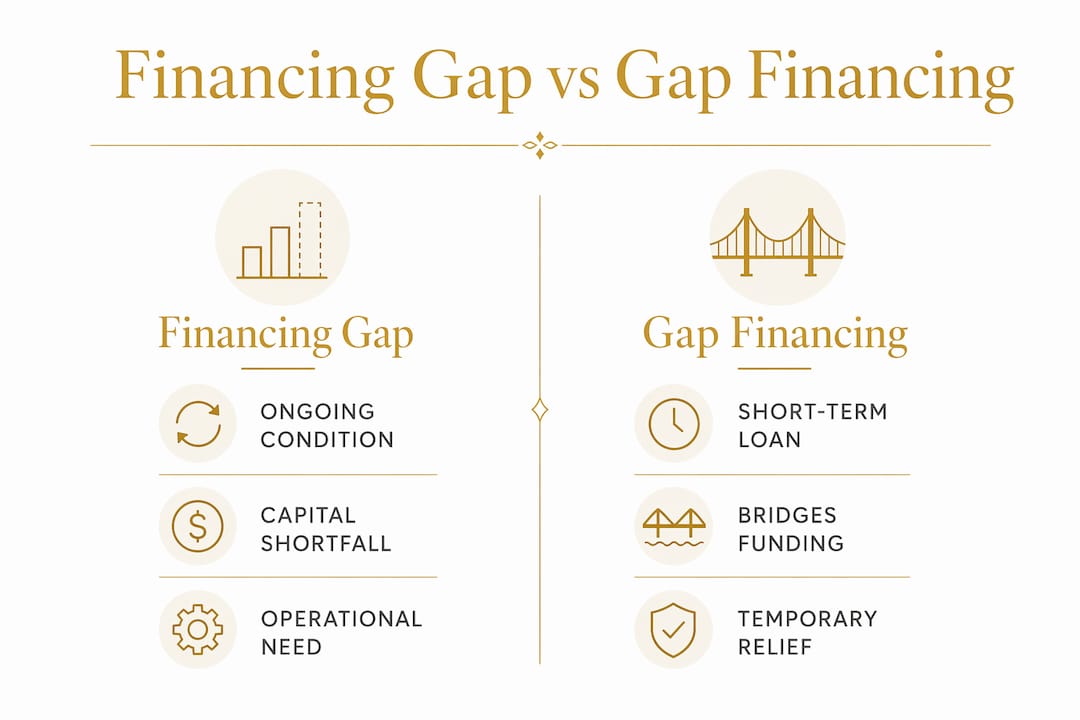
These two terms sound nearly identical and cause expensive confusion. A financing gap is an ongoing condition, the structural shortfall between your resources and your capital needs. Gap financing is a specific product: a short-term loan used to cover an immediate funding need until permanent capital is secured.
Confusing the two leads to a predictable mistake. A business owner identifies a recurring financing gap, takes out a short-term bridge loan to cover it, and then finds the same gap waiting at the end of the loan term. The cost of misidentifying the problem is compounding debt with no structural fix underneath it.
When gap financing is the right tool:
- A commercial real estate deal closes in 90 days, but you need to cover operating costs now
- A large purchase order arrives and you need inventory capital before the customer pays
- A seasonal dip creates a temporary cash shortfall that reverses within one quarter
- Equipment breaks down unexpectedly and you need a fast capital injection before revenue resumes
When gap financing is the wrong tool:
- Your business runs a financing gap every single month
- Revenue growth consistently lags behind expense growth
- You are using short-term debt to fund long-term assets like equipment or leasehold improvements
Pro Tip: Before taking any loan, classify your gap first. Ask whether this shortfall is a one-time event or a pattern. If it is a pattern, you need a long-term capital structure review, not another bridge loan.
What causes financing gaps in small businesses?
Persistent financing gaps often signal deeper problems in financial planning, not just bad luck. Understanding the root cause determines which solution actually works.
Rapid growth is the most counterintuitive cause. A business winning new contracts faster than it can collect payment will run a financing gap even while revenue climbs. Growth consumes cash before it generates cash, and that lag creates the shortfall.
Seasonal revenue swings create predictable but dangerous gaps. Businesses with cyclical sales must fund off-peak operations from reserves or credit. A landscaping company earns most of its revenue between april and october. The november through march period requires a plan, not improvisation.
Slow-paying customers are a structural problem disguised as a cash flow problem. When your receivables average 75 days but your payables average 30, you are permanently financing your customers’ operations with your own capital. Tightening payment terms or using invoice factoring directly shrinks this gap.
Unexpected expenses include equipment failure, regulatory fines, a key employee departure, or a supply chain disruption. These events do not create a structural gap, but they expose businesses that carry no reserves. A single unexpected cost can push a healthy business into a funding shortfall overnight.
The distinction between recurring and one-time gaps matters enormously. A one-time gap calls for a targeted short-term fix. A recurring gap calls for a redesign of how the business manages working capital and its overall capital structure.
How do you close a financing gap effectively?
Closing a financing gap requires matching the solution to the cause. Using the wrong tool wastes money and delays the real fix.
Improve receivables collection
The fastest way to shrink a financing gap is to collect faster. Offer a 1–2% early payment discount to customers who pay within 10 days. Switch from net-60 to net-30 terms on new contracts. Send invoices the same day work is completed, not at the end of the month. Each of these changes directly reduces the timing mismatch that creates most operational financing gaps.
Build a contingency reserve
A reserve fund is not idle money. It is insurance against the emergency funding rounds that damage your credit profile. Set a target of covering 60–90 days of fixed operating expenses in a dedicated account. Build toward it incrementally, even if you start with one week of coverage. Lenders view a business with reserves as a lower risk, which improves your terms on any future financing.
Match financing type to gap type
| Gap type | Recommended financing | Why it fits |
|---|---|---|
| One-time, short-term | Line of credit or bridge loan | Flexible draw and repayment matches temporary need |
| Seasonal, predictable | Revolving credit facility | Borrow during slow season, repay during peak |
| Growth-driven, recurring | Term loan or equity | Permanent capital for permanent growth needs |
| Equipment-related | Equipment financing | Asset secures the loan, preserving working capital |
Matching the financing type to the gap type prevents the debt spiral that comes from using short-term products to fund long-term needs. A business financing options list can help you identify which category fits your situation.
Disclose gaps proactively with lenders
Transparency about financing gaps improves your creditworthiness, not the opposite. Regulators and banks treat a business owner who can explain their gap, show the calculation, and present a plan as a stronger credit candidate than one who appears unaware of the problem. Hiding a gap does not make it invisible to underwriters. Explaining it with a solution does make you look competent.
Key takeaways
A financing gap is the specific dollar amount of external capital a business needs when its current assets, excluding cash, fall short of its current liabilities, and closing it requires matching the right financing tool to the right cause.
| Point | Details |
|---|---|
| Core definition | A financing gap equals current assets minus cash minus current liabilities; a positive result means external capital is needed. |
| Gap vs. gap financing | A financing gap is an ongoing condition; gap financing is a short-term loan product used for temporary shortfalls only. |
| Common causes | Rapid growth, slow-paying customers, seasonal swings, and unexpected expenses each create gaps with different solutions. |
| Contingency reserve | Add a 10–20% buffer to your gap calculation to avoid emergency refinancing, which signals instability to lenders. |
| Transparency pays | Disclosing and explaining your financing gap to lenders improves your credit profile and access to capital. |
The pattern I see business owners repeat
Most business owners I talk to discover their financing gap at the worst possible moment: when payroll is due in four days and the bank account cannot cover it. That is not a financing gap problem. That is a monitoring problem.
The gap existed weeks or months earlier. It was visible in the receivables aging report, in the inventory levels, in the payable due dates. The business owner just was not looking at those numbers together in one calculation. Running a monthly financing gap analysis, even a rough one on a spreadsheet, changes that entirely. You see the shortfall coming with enough time to act.
The second pattern I see is reaching for the nearest loan product instead of the right one. A revolving line of credit is a genuinely useful tool for seasonal gaps. It becomes a liability when a business uses it to fund equipment purchases or leasehold improvements because those assets take years to generate returns. The financing mistakes that compound fastest are almost always about mismatching the loan term to the asset life.
My honest advice: run the formula every month, build even a small reserve, and talk to your lender before you need them, not after. A lender who sees a business owner who tracks their gap and plans around it will offer better terms than one who sees a business owner in crisis mode.
— Jason
Funding gaps do not have to stop your growth
Identifying a financing gap is not a sign that your business is failing. It is a sign that your business is real. Every growing company faces the gap between what it earns and what it needs to keep moving forward.

Emorylending evaluates your business performance and cash flow, not just your personal credit score, so more business owners get the capital they actually need. Whether you are covering a seasonal shortfall, funding a growth push, or managing a receivables delay, Emorylending offers financing from $5,000 to $5,000,000+. Read the flexible financing guide to see which options fit your situation, or check the full financing options list to compare products side by side.
FAQ
What is a financing gap in simple terms?
A financing gap is the amount of money a business needs from outside sources when its available resources cannot cover its operating or growth costs. It is calculated as current assets minus cash minus current liabilities.
How is a financing gap different from a funding gap?
The terms are used interchangeably in most contexts. Both describe the shortfall between a company’s internal capital and the amount it needs to operate or grow. Some analysts use “funding gap” in a broader policy context, but the core meaning is identical for business owners.
What is gap financing and when should I use it?
Gap financing is a short-term loan designed to cover an immediate cash shortfall until permanent capital is in place. Use it for one-time, temporary needs. Do not use it to cover a recurring structural gap, as that leads to compounding debt without fixing the underlying problem.
How do I identify a financing gap in my business?
Run the formula monthly: subtract cash from your current assets, then subtract your current liabilities. A positive result is your gap. Also monitor your cash conversion cycle to catch timing mismatches between what customers owe you and what you owe suppliers.
Does having a financing gap hurt my chances of getting a loan?
Not if you disclose it clearly and present a plan. Lenders and regulators treat transparent gap disclosure as a positive indicator of financial awareness. Hiding a gap or appearing unaware of it is far more damaging to your credit profile than acknowledging it directly.


