

Payroll funding is defined as short-term financing that gives small businesses immediate working capital to cover employee wages when cash flow timing creates a gap between money owed and money in hand. The industry standard term is payroll financing, and both terms describe the same mechanism. This guide covers what payroll financing is, which options fit which situations, how to qualify, and how to avoid the traps that cost business owners far more than the original funding. Whether you run a staffing agency waiting on client invoices or a retail shop managing seasonal slowdowns, the right payroll funding strategy keeps your team paid and your business moving. Providers like Justworks, Remote, and Emorylending each approach this space differently, and knowing those differences matters.
What are the common payroll funding options for small businesses?
Payroll financing comes in four main forms, and each one fits a different cash flow situation. Choosing the wrong type is one of the most common and expensive mistakes small business owners make.
Invoice factoring works by selling your unpaid invoices to a third-party lender at a discount in exchange for immediate cash. Payroll funding solutions can provide advances covering up to 80% to 100% of payroll expenses depending on lender risk assessment. That range matters because a lender offering 80% still leaves a 20% gap you need to cover from reserves. Invoice factoring works best when your clients are creditworthy businesses with predictable payment cycles. The downside is that invoice factoring can carry minimum monthly fees, making it cost-effective mainly when invoice volumes are consistently high.
Payroll loans are direct short-term loans specifically structured to cover payroll. Approval is faster than traditional bank loans, often within a few days, and funds can be disbursed within 24 to 48 hours for repeat borrowers. Interest rates start around 1.5% weekly plus one-time transaction fees, with some lenders also charging application or prepayment penalties. That 1.5% weekly rate compounds quickly, so a 30-day loan effectively costs around 6% of the principal before fees.
Business lines of credit offer the most flexibility. You draw only what you need, repay it, and draw again. This structure suits businesses with recurring but unpredictable payroll gaps rather than a single large shortfall. The cost per dollar borrowed is typically lower than a payroll loan, and a well-managed line of credit builds your borrowing history with the lender.

Merchant cash advances (MCAs) are the most expensive option and carry the highest risk. MCAs involve daily repayments deducted directly from credit card sales, which can worsen cash flow issues rather than solve them. Reserve MCAs as a last resort when no other option is available and the cost of missing payroll exceeds the cost of the advance.
| Funding type | Best for | Speed | Relative cost |
|---|---|---|---|
| Invoice factoring | B2B businesses with outstanding invoices | 1 to 3 days | Moderate |
| Payroll loan | One-time or seasonal payroll gaps | 1 to 5 days | Moderate to high |
| Business line of credit | Recurring, unpredictable gaps | 1 to 7 days | Lower |
| Merchant cash advance | Last resort only | Same day | Very high |
What qualifications do lenders require for payroll funding?
Lenders evaluate payroll funding applications on a narrow set of criteria, and knowing those criteria before you apply saves time and protects your credit profile from unnecessary hard inquiries.
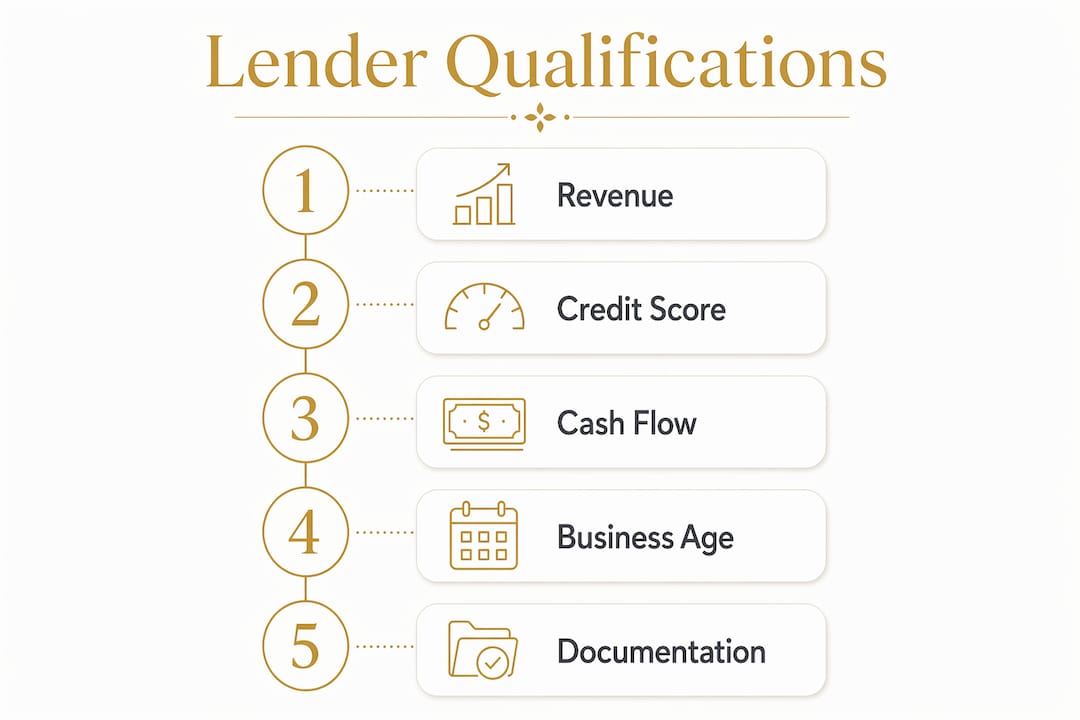
Standard benchmarks include 2+ years of business age and a minimum of 5 employees. Those thresholds exist because lenders need evidence of operational stability and a payroll track record large enough to assess risk accurately. A business that has been running for 18 months with 3 employees is not automatically disqualified everywhere, but it will face fewer options and higher rates.
Beyond age and headcount, lenders typically request the following:
- Three to six months of business bank statements showing consistent revenue deposits
- Payroll records demonstrating a regular pay cycle and total payroll obligations
- Accounts receivable aging reports if you are applying for invoice factoring
- A current profit and loss statement or cash flow projection
- Business tax returns for the most recent one to two years
Revenue predictability carries more weight than raw revenue size. A business generating $40,000 per month with consistent deposits is a stronger candidate than one averaging $60,000 with erratic timing. Lenders use cash flow statements to model whether your business can service the debt without creating a new shortfall.
Pro Tip: Before applying, pull your own business credit report from Dun & Bradstreet or Experian Business. Errors on these reports are common and can drop your score enough to push you into a higher rate tier. Correcting them before you apply costs nothing and can save thousands.
Creditworthiness also affects the advance percentage you receive. A business with strong financials may receive 95% to 100% of payroll covered, while a higher-risk profile may receive only 80%. That gap directly affects how much supplemental cash you need to keep on hand.
How do you apply for payroll funding and manage repayments?
The application process for payroll financing follows a predictable sequence. Moving through it methodically reduces errors and speeds approval.
- Assess your actual funding need. Calculate the exact payroll amount due, including taxes and benefits, not just gross wages. Overborrowing increases your repayment burden without adding value.
- Gather your documents before contacting lenders. Bank statements, payroll records, and tax returns should be current and organized. Incomplete applications are the leading cause of delays.
- Compare at least three lenders. Rates, fees, advance percentages, and repayment structures vary significantly. A lender charging a $150 transaction fee on a $10,000 advance is cheaper than one charging 2% weekly even if the weekly rate sounds small.
- Submit your application and respond to requests promptly. Lenders may ask for additional documentation during underwriting. A 24-hour delay on your end can push disbursement past your payroll date.
- Confirm disbursement timing in writing. Initial approvals take a few days, with subsequent funding often processed within 24 to 48 hours. Know exactly when funds will hit your account relative to your payroll run.
- Build your repayment schedule around your cash flow cycle. If your clients pay on net-30 terms, structure repayment to begin after those payments clear, not before.
Pro Tip: Set up a dedicated business checking account solely for payroll funding draws and repayments. This creates a clean paper trail for your accountant, simplifies reconciliation, and makes it immediately visible if a repayment is pulling more than expected from your operating account.
Monitoring total cost of capital is non-negotiable. Add up every fee, including application charges, transaction fees, and weekly interest, before signing. Some providers base fees on gross payroll totals rather than invoice volume, which removes invoice liability but can increase total cost for smaller payroll amounts. Compare the all-in cost, not just the headline rate.
What mistakes and risks should you avoid with payroll financing?
The most damaging mistake is treating payroll financing as a permanent operating budget line rather than a temporary bridge. Payroll funding is most effective as a short-term tool to bridge cash flow gaps caused by cyclical slowdowns or long client payment cycles. Using it to cover ongoing operational deficits signals a structural revenue problem that financing will only delay and worsen.
The second major risk is overreliance. Each draw adds repayment obligations to future cash flow, which can create a cycle where you borrow to cover payroll, then borrow again because repayments depleted the cash you needed for the next cycle. Payroll funding must not be relied upon as a crutch for poor cash management.
Watch for these specific pitfalls:
- Hidden fees: Application fees, wire transfer charges, and prepayment penalties can add 1% to 3% to your effective rate without appearing in the headline terms.
- Client perception with invoice factoring: When a factoring company contacts your clients directly to collect, some clients interpret this as a sign of financial distress. Vet your factoring provider’s collection practices before signing.
- Short repayment windows: Some payroll loans require full repayment within 30 days. If your revenue cycle is longer than that, you will be repaying before your next client payment arrives.
Payroll financing works best when you treat it like a precision tool, not a safety net. Use it for a defined gap, with a defined exit, and a clear plan for what changes once the gap closes.
What are best practices for managing payroll funding alongside cash flow?
Integrating payroll financing with your broader financial management turns a reactive tool into a proactive strategy. Combining payroll funding with payroll automation technologies enhances cash flow visibility and control, promoting smarter financial management overall.
Practical steps that work:
- Use payroll automation software such as Gusto, QuickBooks Payroll, or ADP Run to track payroll obligations in real time. Knowing your exact payroll liability 30 days out lets you plan funding requests before a crisis, not during one.
- Run a monthly cash flow projection. Map expected inflows against payroll dates, loan repayments, and fixed expenses. This single habit catches shortfalls three to four weeks before they become emergencies.
- Maintain a cash reserve equal to one payroll cycle. Even a partial reserve reduces your dependence on external financing and gives you negotiating leverage with lenders.
- Diversify your funding sources. A business line of credit from Emorylending combined with invoice factoring for high-invoice months gives you flexibility that a single funding source cannot.
Certain funding solutions integrate directly with payroll software, allowing real-time visibility, automated disbursements, and compliance tracking. This integration reduces manual errors and speeds fund access, which matters most when payroll is 48 hours away. For guidance on building the financial foundation that reduces your need for emergency payroll financing, the cash flow management process at Emorylending covers the full framework.
When your cash flow challenges go beyond a single payroll cycle, consulting a financial professional adds perspective that software alone cannot provide. Advisors who specialize in small business financing, including those at Asset Life Settlements, can help you assess whether your current funding structure fits your growth trajectory.
Key takeaways
Payroll financing works best as a short-term, precisely targeted tool that bridges defined cash flow gaps, not as a substitute for sound financial management.
| Point | Details |
|---|---|
| Know your options | Invoice factoring, payroll loans, lines of credit, and MCAs each fit different situations and cost profiles. |
| Meet lender benchmarks | Most lenders require 2+ years in business and at least 5 employees before approving payroll funding. |
| Calculate all-in cost | Weekly rates starting at 1.5% plus fees can compound fast; compare total cost, not just the headline rate. |
| Avoid dependency | Using payroll financing repeatedly to cover ongoing deficits signals a structural problem that borrowing cannot fix. |
| Automate and project | Payroll automation tools and monthly cash flow projections let you plan funding requests before a crisis hits. |
Why payroll funding is a tool, not a lifeline
I have worked with hundreds of small business owners who came to payroll financing in a panic, and the ones who used it well all had one thing in common: they knew exactly why they needed it and exactly when they would not need it anymore. The owners who struggled treated each draw as a solution rather than a bridge.
The part most guides skip is the psychological trap. Once you have used payroll financing successfully, it becomes tempting to reach for it again the next time cash feels tight, even when the underlying problem is a pricing issue or a client mix that is too concentrated. Payroll funding improves employee morale and retention by keeping wages on time, and that benefit is real. But it does not fix the revenue problem that created the gap.
My honest recommendation is to use payroll financing once or twice to buy yourself time, then spend that time fixing the root cause. Tighten your invoicing terms. Build a one-cycle cash reserve. Diversify your client base so no single slow payer can threaten your payroll. The cash flow strategies that reduce your need for payroll financing are the same ones that make your business fundable at better rates when you do need capital.
Technology helps more than most owners realize. When your payroll software talks to your accounting platform and your lender’s portal, you stop making funding decisions based on gut feel and start making them based on actual numbers. That shift alone changes the outcome.
— Jason
How Emorylending helps you cover payroll without the stress

Emorylending evaluates your business performance and cash flow, not just your personal credit score, which means more small businesses qualify for the capital they need to keep operations running. Whether you need working capital to cover a single payroll cycle or a flexible line of credit to manage recurring gaps, Emorylending offers business financing options from $5,000 to $5,000,000+. Approvals move fast, repayment terms are built around your cash flow cycle, and the process is straightforward. If you are waiting on receivables or managing a seasonal slowdown, explore alternative funding solutions designed specifically for situations like yours.
FAQ
What is payroll funding for small businesses?
Payroll funding, also called payroll financing, is short-term financing that provides immediate working capital to cover employee wages when a business faces a temporary cash flow gap. It is not a long-term solution but a bridge between money owed and money available.
How fast can a small business get payroll funding?
Initial approval typically takes a few days, and subsequent funding requests are often processed and disbursed within 24 to 48 hours. Speed depends on how quickly you provide required documentation and your lender’s underwriting process.
What are the typical costs of payroll financing?
Interest rates start around 1.5% weekly plus one-time transaction fees, with some lenders adding application fees or prepayment penalties. Always calculate the total all-in cost before signing, not just the weekly rate.
Is invoice factoring a good option for payroll funding?
Invoice factoring works well for B2B businesses with consistent, high invoice volumes, since some providers charge minimum monthly fees that make it expensive at low volumes. Conduct a cost-benefit analysis based on your actual invoice frequency before choosing this route.
How do I reduce my reliance on payroll financing over time?
Build a cash reserve equal to at least one payroll cycle, tighten your client payment terms, and use payroll automation software to project shortfalls 30 days in advance. Improving overall cash flow visibility is the most direct path to needing less external financing.


