

Risk assessment for business loans is the process lenders use to measure the probability that a borrower will repay debt on time and in full. The industry term is credit risk analysis, and it combines hard financial data with qualitative judgment to determine whether a loan is sound. Every lender, from a community bank to a fintech platform, runs some version of this process before approving a dollar. Understanding how it works gives you a real advantage when you apply.
What factors do lenders evaluate during business loan risk assessments?
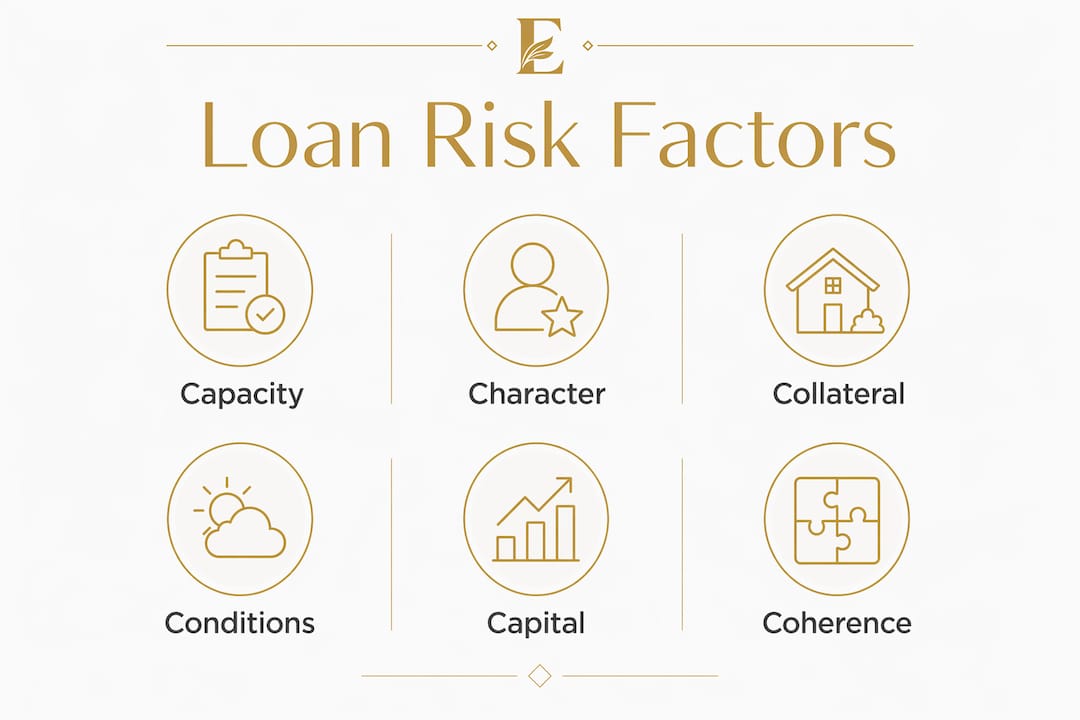
The 5 Cs of Credit is the foundational framework lenders use to explain risk assessment for business loans: Capacity, Character, Capital, Collateral, and Conditions. Each C targets a different dimension of risk. Together, they give the lender a complete picture of whether your business can and will repay.
Capacity is the most predictive factor. It measures your ability to generate enough cash flow to cover debt payments. Lenders calculate your debt service coverage ratio (DSCR) to quantify this. A business that can only service debt under perfect conditions will likely be declined.

Character reflects the owner’s track record. Lenders pull credit bureau data and references to assess past loan performance and payment behavior. Strong repayment history builds lender confidence. A pattern of late payments or defaults raises a red flag regardless of current revenue.
Capital shows how much the owner has invested in the business. Lenders read high owner equity as a sign of commitment and a financial cushion. Collateral is a secondary factor. It gives the lender a recovery path if the loan goes bad, but collateral alone never rescues a loan that lacks credible repayment capacity.
Conditions cover the external environment:
- Industry trends and competitive position
- Macroeconomic factors like interest rates and inflation
- Regulatory changes affecting your sector
- The specific purpose of the loan and whether it aligns with your cash flow forecast
A sixth factor, Coherence, has become standard in modern underwriting. Document coherence means every figure in your application, tax returns, bank statements, and financial projections, must reconcile with every other figure. Discrepancies trigger immediate declines, regardless of how strong the underlying business is.
How has technology changed the risk assessment process for business loans?
Fintech has fundamentally changed how lenders conduct business financing risk analysis. The shift from manual to automated underwriting is the biggest change in lending in a generation.
Traditional underwriting required loan officers to manually collect bank statements, verify income, and cross-check documents. That process took weeks. Fintech-enabled underwriting uses real-time digital data connections to pull bank statements and cash flow data directly from source systems. Decisions that once took weeks now take days or hours.
Automation also improves accuracy. Automated systems flag anomalies in financial data instantly. A manual reviewer might miss a subtle inconsistency between a tax return and a bank statement. An algorithm catches it in seconds. That capability strengthens fraud detection and protects both lender and borrower.
The technology shift has also expanded credit access. Lenders can now analyze alternative data sources, including payment processor records, utility payments, and e-commerce revenue, to evaluate businesses with thin credit files. A startup with 18 months of strong Stripe or Square transaction history can now qualify for financing that would have been out of reach under purely traditional underwriting.
- Connect your accounts digitally. Give lenders direct access to your bank and accounting data rather than submitting static PDFs. Real-time data reduces back-and-forth and speeds up decisions.
- Keep your accounting software current. Lenders using automated systems pull live data. Outdated or inconsistent records create flags.
- Reconcile your statements before applying. Run a coherence check yourself. Compare your tax returns, profit and loss statements, and bank statements for any figures that do not match.
- Use your payment processor data as an asset. If you process payments through a digital platform, that transaction history is a credible data source for lenders evaluating your cash flow.
Pro Tip: Before you submit any application, download 12 months of bank statements and compare the ending balances to your accounting records. Any gap you find, the lender will find too.
What common pitfalls do business owners face during risk assessments?
Most loan application failures trace back to a small set of avoidable mistakes. Knowing them in advance puts you in a much stronger position.
Fixating on profit instead of cash flow. Business owners often present strong net income figures and expect approval. Lenders focus on durable, stress-tested cash flow, not accounting profit. A business can be profitable on paper and still fail to generate enough cash to cover a monthly loan payment. Lenders know this and look past the income statement to actual cash movement.
Relying on collateral as the primary repayment argument. Pledging real estate or equipment does not substitute for demonstrable repayment capacity. Lenders rely primarily on cash flow from operations. Collateral is a recovery tool, not a lending basis. Presenting collateral as your main argument signals that you do not have a credible repayment plan.
Submitting inconsistent financial documents. Underwriters apply a coherence check to every application. A mismatch between your tax return and your bank statement, even an innocent bookkeeping error, can trigger an immediate decline. Clean, reconciled documents are non-negotiable.
Here are the most common pitfalls and how to avoid them:
- Unrealistic cash flow forecasts. Lenders stress-test your projections. If your forecast assumes 20% revenue growth with no explanation, expect pushback. Base projections on historical performance and document your assumptions.
- Undefined loan purpose. Loan purpose must align with your cash flow forecasts. Saying you need capital for “general business purposes” without specifics raises lender concerns. Define exactly what the funds will do and how that use generates or protects cash flow.
- Neglected credit history. Your personal credit score still matters, especially for small businesses. Pay down revolving balances, resolve any delinquencies, and avoid opening new credit lines in the 90 days before applying.
- No preparation for industry headwinds. If your sector faces known challenges, address them directly in your application. Lenders will raise the issue. Getting ahead of it shows awareness and management capability.
Pro Tip: Prepare a one-page loan narrative that explains your business, the loan purpose, and your repayment plan in plain language. Lenders read hundreds of applications. A clear narrative makes yours stand out and reduces underwriter questions.
How do lenders use financial ratios to quantify loan risk?
Lenders translate qualitative judgment into numbers through financial ratios. These ratios give underwriters a consistent, comparable measure of risk across different businesses and industries.
The debt service coverage ratio (DSCR) is the most important metric in capacity assessment. DSCR equals net operating income divided by total annual debt service. A DSCR benchmark of 1.25x is the standard minimum for most commercial loan approvals. A ratio of 1.25x means your business generates $1.25 in operating income for every $1.00 of debt payment. That 25-cent cushion is what lenders call a margin of safety.
Some lenders calculate a global DSCR that incorporates the guarantor’s personal income and obligations alongside the business figures. This matters for sole proprietors and small partnerships where personal and business finances overlap significantly.
| Ratio | What it measures | Typical benchmark |
|---|---|---|
| DSCR | Ability to cover debt payments from operating income | 1.25x minimum |
| Leverage ratio | Total debt relative to equity or assets | Varies by industry |
| Current ratio | Short-term assets vs. short-term liabilities | 1.0x or higher |
| Debt-to-equity | Total liabilities relative to owner equity | Lower is stronger |
Leverage ratios measure how much debt a business carries relative to its equity or assets. High leverage signals fragility. A business with thin equity and heavy debt has little room to absorb a revenue drop. Liquidity ratios, like the current ratio, show whether a business can meet near-term obligations without selling long-term assets.
Ratios are never read in isolation. A DSCR of 1.10x in a stable, low-risk industry may be acceptable. The same ratio in a cyclical sector with volatile revenue would likely result in a decline or a higher interest rate. Understanding business performance in lending decisions means knowing that numbers always carry context.
Key Takeaways
Lenders approve business loans based primarily on durable cash flow, supported by clean financial documents, a clear loan purpose, and ratios like DSCR that prove repayment capacity.
| Point | Details |
|---|---|
| Cash flow is the primary factor | Lenders focus on stress-tested operating cash flow, not accounting profit. |
| The 5 Cs framework guides every assessment | Capacity, Character, Capital, Collateral, and Conditions each carry distinct weight. |
| Document coherence is a hard requirement | Inconsistent financial records trigger immediate declines regardless of business strength. |
| DSCR of 1.25x is the standard benchmark | A ratio below this threshold signals insufficient repayment capacity for most lenders. |
| Technology has accelerated underwriting | Fintech tools reduce approval timelines from weeks to hours using real-time data. |
What I’ve learned about risk assessment after years in lending
Most business owners walk into a loan application thinking about what they need. Lenders think about what could go wrong. That gap in perspective is where most applications fall apart.
The single most important shift you can make is to start thinking like an underwriter before you apply. Pull your own financials. Calculate your DSCR. Read your bank statements the way a lender would. If you see a month where cash dropped sharply, prepare an explanation. If your tax return shows a loss year, be ready to contextualize it. Lenders are not looking for perfection. They are looking for transparency and a credible story.
The businesses I have seen succeed in the loan process share one trait: they treat the application as a presentation, not a form. They know their numbers cold, they document their assumptions, and they address risk factors proactively rather than hoping the lender does not notice. That approach builds trust faster than any collateral pledge ever could.
Building creditworthiness is a long game. Pay suppliers on time, maintain clean books, and keep your credit assessment profile current. The business owners who do this consistently find that when they need capital, the process moves quickly. The ones who scramble to clean up their records at application time almost always face delays or declines.
— Jason
How Emorylending supports business owners through the financing process
Emorylending evaluates your business performance and cash flow, not just your personal credit score. That approach opens financing to businesses that traditional lenders routinely decline.
Whether you need working capital to cover payroll, equipment financing to expand capacity, or funds to bridge a receivables gap, Emorylending structures financing around what your business actually does. The application process is direct, the criteria are transparent, and decisions move fast. Explore your flexible financing options and see what your business qualifies for today. Funding ranges from $5,000 to $5,000,000+, with terms built for real business needs.
FAQ
What is the most important factor in business loan risk assessment?
Capacity is the most predictive factor. Lenders focus on whether your business generates enough cash flow to cover debt payments, measured primarily through the debt service coverage ratio.
What DSCR do I need to qualify for a business loan?
Most commercial lenders require a minimum DSCR of 1.25x. This means your operating income must be at least 25% higher than your total annual debt payments.
Why do lenders decline loans with strong collateral?
Lenders rely on cash flow from operations as the primary repayment source. Collateral is a recovery tool for default scenarios, not a substitute for demonstrated repayment capacity.
How does technology affect my loan application?
Fintech underwriting connects directly to your bank and accounting data in real time. This speeds up decisions from weeks to hours and improves the accuracy of cash flow and fraud analysis.
What documents should I prepare for a business loan application?
Prepare 12 months of bank statements, two years of tax returns, current profit and loss statements, and a cash flow forecast. All figures must reconcile across every document to pass the coherence check.


