

The role of documentation in business loans is straightforward: prove who is borrowing, verify cash flow and tax compliance, and give lenders the legal foundation to enforce the agreement if something goes wrong. Every document in your file answers one of four underwriting questions — who you are, how your business performs, whether you can personally back the loan, and whether your tax records and bank statements tell the same story.
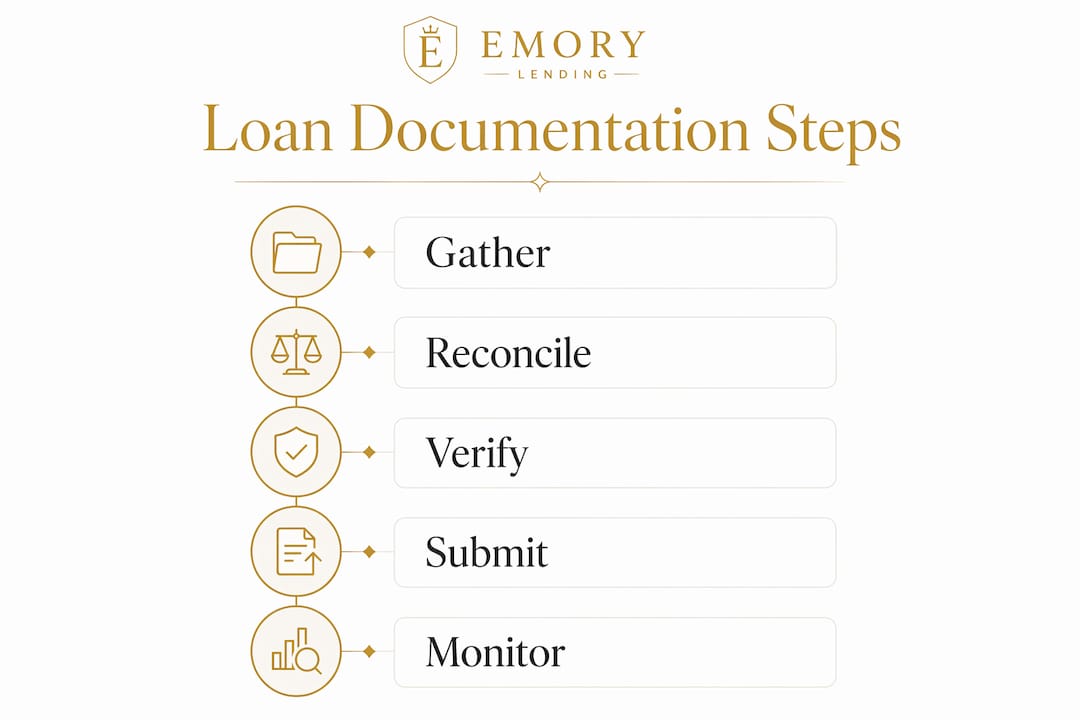
Before you contact a lender, pull these together first:
- Business and personal tax returns covering multiple years
- Business profit and loss statement plus balance sheet (current within a recent period)
- Business bank statements covering several recent months
- Business debt schedule
- Personal financial statement (SBA Form 413 for SBA loans), commonly required for certain owners
- Formation and ownership documents (articles of incorporation, operating agreement)
- Collateral records (titles, deeds, equipment schedules)
- Use-of-funds statement
- SBA Form 1919 (SBA loans only)
Table of Contents
- Why does documentation matter so much to lenders?
- What documents do you actually need to gather?
- Does documentation change depending on the loan type?
- What are representations, warranties, and covenants?
- How does documentation quality change your loan terms?
- What does the underwriting timeline actually look like?
- How do you build a lender-ready document stack?Sequence your work to remove the most common underwriting blockers before the lender ever sees your file.
- What if you don’t have all the documents?
- When should you bring in a professional?
- Key Takeaways
- Why documentation mistakes are more expensive than most owners expect
- Emorylending helps you get your application file right the first time
- Useful sources and further reading
Why does documentation matter so much to lenders?
Lenders use documentation primarily as a risk-management tool. They are not just collecting paperwork; they are validating that your stated performance matches your cash flow, your tax filings, and your ownership structure. A file that tells a consistent story moves fast. One that contradicts itself stalls.
The four questions every underwriter is trying to answer: Who is this borrower? Does the business generate enough cash to repay? Can the owner personally back the obligation? Do the tax returns and bank deposits agree? FDIC supervisory guidance frames documentation as the mechanism that answers all four before a single dollar is committed.
Lenders also use compliance certificates and reporting requirements to shift ongoing monitoring responsibility to borrowers. Failing to meet those reporting obligations after closing can create technical defaults, even when payments are current.
What documents do you actually need to gather?
The core file for most business loans runs about ten items. Here is how to prioritize them:
Must-have first (reconcile these before anything else):
- Business and personal tax returns, 3 years. Underwriters pull IRS transcripts to verify these independently. A mismatch between your reported income and bank deposits is one of the most common reasons for immediate rejection.
- P&L and balance sheet, current within 60–90 days. These prove operating performance and net worth. An interim statement dated more than 90 days ago will likely trigger a request for updated figures.
- Business bank statements, 3–12 months. Month count depends on lender and product. SBA lenders often want 12; online lenders may accept 3–6.
- Personal financial statement. Owners with 20% or more equity are typically required to provide this and may need to sign a personal guarantee.
- Business debt schedule. Lists all existing obligations so the underwriter can calculate debt-service coverage accurately.
Secondary but still required:
- Formation documents (articles of incorporation, operating agreement, EIN confirmation)
- Business licenses and any required permits
- Collateral documentation (titles, deeds, equipment schedules)
- Use-of-funds statement explaining how proceeds will be deployed
- Business plan or executive summary (required for SBA; helpful for all)
Pro Tip: Before you submit, reconcile your bank deposits to your P&L and tax returns line by line. Underwriters cross-check all three. An unexplained gap — even a timing difference — frequently triggers a callback that adds weeks to the process.
Does documentation change depending on the loan type?

Yes, and the differences are significant. SBA and asset-based products require stricter, itemized proof than most online term loans.
| Loan Type | Key Additional Documents | Common Stall Point |
|---|---|---|
| SBA 7(a) | Form 413, Form 1919, equity injection evidence, business plan | Missing equity injection proof or unsigned Form 1919 |
| Conventional term loan | 3 years tax returns, audited or reviewed financials for larger amounts | Stale financials or unreconciled P&L |
| Business line of credit | 6–12 months bank statements, current P&L | Insufficient deposit history or low average balance |
| Equipment financing | Equipment quotes or invoices, titles on trade-ins, insurance binders | Missing vendor quote delays funding entirely |
| Invoice factoring | Accounts receivable aging report, customer list, sample invoices | Undisclosed liens on receivables |
A missing equipment quote on an equipment loan is not a minor gap. Lenders cannot approve a specific dollar amount without knowing the asset’s cost, so that single missing document can freeze the entire file until it arrives.
What are representations, warranties, and covenants?
These three legal concepts are the backbone of every loan agreement, and they are where small-business owners most often get surprised after signing.
Representations are your factual statements at the time of closing — that your financials are accurate, that no material litigation is pending, that you own the collateral free and clear. Warranties are promises that those representations remain true over time. Covenants are ongoing behavioral obligations: maintain a minimum debt-service coverage ratio, provide quarterly financials, get lender approval before taking on new debt.
Common red flags to watch for: broad negative covenants that restrict normal business decisions (hiring, capital expenditures, new leases), vague reporting deadlines, and off-balance-sheet liabilities that your reps may not have disclosed. Incomplete collateral documentation can turn a secured loan effectively unsecured if the UCC filing or title work is inconsistent with the loan documents.
Review every rep, warranty, and covenant with legal counsel before you sign. The cost of a one-hour attorney review is trivial compared to a technical default triggered by a covenant you did not fully understand.
How does documentation quality change your loan terms?
Cleaner files produce faster approvals, better pricing, and fewer restrictive covenants. The relationship is direct.
- Reconciled bank statements + audited financials reduce perceived risk, which can lower your rate or increase the available loan size.
- Missing or stale tax returns often force lenders to price in uncertainty, which means higher rates or a personal guarantee requirement.
- Document mismatch (deposits don’t match reported revenue) triggers additional conditions and sometimes a full re-underwrite.
- Detailed collateral documentation with clear title and proper perfection can reduce the lender’s UCC reach or eliminate the need for a blanket lien on all business assets.
- Incomplete ownership disclosure can delay closing by weeks while the lender verifies the full ownership structure.
The factors that affect loan approval are not mysterious. Documentation quality is one of the few variables you control entirely before you apply.
What does the underwriting timeline actually look like?
Expect several months for many conventional term loans, shorter for simple online products, and longer timelines when SBA underwriting or collateral perfection is involved. State-level variations in title work and UCC filing timelines add additional variability.
Common steps that cause delays:
- IRS transcript verification (lenders request these via Form 4506-C; IRS processing adds time)
- Property appraisals and environmental reviews for real estate collateral
- UCC searches and lien releases on existing collateral
- Title work for real property or titled equipment
Third-party costs to budget for: appraisal fees, environmental review fees, legal review of closing documents, UCC filing fees, and title insurance premiums. These vary by state, loan size, and collateral type, but they are real costs that appear during underwriting, not at application.
How do you build a lender-ready document stack?Sequence your work to remove the most common underwriting blockers before the lender ever sees your file.
- Reconcile bank deposits to your P&L and tax returns. Fix any gaps or timing differences before submission.
- Assemble three years of business and personal tax returns and request IRS transcripts proactively via Form 4506-C.
- Build a one-page loan summary covering loan amount, purpose, repayment source, and business overview. Put this at the top of your file.
- Gather collateral evidence and third-party quotes (equipment invoices, property appraisals, titles).
- Prepare owner personal financial statements and government-issued ID for all owners with 20% or more equity.
Organize files in clearly labeled folders: “01_Tax Returns,” “02_Financial Statements,” “03_Bank Statements,” “04_Ownership Docs,” “05_Collateral,” “06_Loan Summary.” Name each file with the document type and year (e.g., “2023_Business_Tax_Return.pdf”).
Pro Tip: Submit your package as a single indexed PDF or via a secure portal link rather than a loose email chain of attachments. Underwriters work faster when the file is pre-organized and they don’t have to hunt for documents.
What if you don’t have all the documents?
Missing documents don’t automatically mean denial. Lenders have more flexibility than most owners realize, especially outside the SBA channel.
Online and alternative lenders often accept bank-statement-based underwriting in place of full tax returns, particularly for working capital products. If your tax returns are incomplete or under amendment, a letter of explanation with supporting evidence (bank statements, interim financials, a CPA letter) can sometimes substitute. A stronger collateral package can offset weaker financial documentation in asset-based deals.
Practical steps to strengthen a thin file: obtain IRS transcripts to confirm what’s on record, secure short-term leases or advance customer contracts that demonstrate future revenue, get equipment quotes to anchor a collateral story, or add a creditworthy guarantor. Comparing financing options across product types is worth doing before you assume your file isn’t ready.
When should you bring in a professional?
Get professional help when covenants are unclear, collateral perfection is complex, or ownership and affiliation issues exist. Those three situations account for most of the costly surprises small-business owners encounter after closing.
Call a business attorney when: the loan agreement contains broad negative covenants, security interests involve real property or complex equipment, or the lender’s reps and warranties are vague about what constitutes a default. Call a CPA when: your financials need reconciliation, you need audited or reviewed statements, or your tax returns require amendment before submission. Call a funding advisor when: you need help matching your documentation profile to the right product, or you want someone to package the file before it goes to a lender.
A small upfront investment in professional review routinely prevents multi-week delays and unfavorable terms that cost far more over the life of the loan.
Key Takeaways
Proper documentation is the single most controllable factor in your loan approval, pricing, and timeline — start with money documents and work outward.
| Point | Details |
|---|---|
| Reconcile money docs first | Match bank deposits to P&L and tax returns before submitting anything to a lender. |
| Collect three years of returns | Business and personal tax returns for three fiscal years are required by most lenders and verified via IRS transcripts. |
| Prepare owner statements early | All owners with 20% or more equity need personal financial statements and may need to sign a personal guarantee. |
| Review covenants with counsel | Representations, warranties, and covenants affect ongoing business conduct — get legal review before signing. |
| Emorylending matches your file to lenders | Emorylending evaluates business performance and cash flow, connecting owners in NC, SC, FL, and VA to lenders suited to their documentation profile. |
Why documentation mistakes are more expensive than most owners expect
The conventional wisdom is that a loan application lives or dies on credit score. That framing misses the real bottleneck. In practice, the files that stall are not the ones with borderline credit — they are the ones where the bank statements, P&L, and tax returns tell three slightly different stories.
Underwriters are trained to find inconsistencies. A deposit pattern that doesn’t match reported revenue, an owner who forgot to include a personal guarantee from a prior loan on their debt schedule, a balance sheet dated five months ago — each of these triggers a callback, and each callback adds days or weeks. The cumulative effect of a disorganized file is often a worse rate or a smaller approval than the business actually qualified for.
The other thing owners underestimate is the ongoing documentation burden after closing. Covenants require quarterly or annual reporting. Compliance certificates have deadlines. Missing one can create a technical default even when you’ve never missed a payment. That is not a hypothetical — it is a documented pattern in loan lifecycle enforcement.
The owners who get the best terms are not necessarily the ones with the strongest businesses. They are the ones who walked in with a clean, reconciled, indexed file and a one-page summary that made the underwriter’s job easy.
Emorylending helps you get your application file right the first time
Getting your documentation in order is the hardest part of the business loan application process for most small-business owners. Emorylending takes a different approach: instead of running your file through a single lender’s rigid checklist, we evaluate your business performance and cash flow, then match your application to lenders who are actually suited to your documentation profile and financing need.
Emorylending works with businesses in North Carolina, South Carolina, Florida, and Virginia, connecting owners to funding from $5,000 to $5,000,000+. Whether you need help packaging an SBA application, matching your bank-statement history to the right working capital product, or understanding which business financing options fit your current file, the process starts with a single application. Submit yours today and let Emorylending do the lender matching for you.
Useful sources and further reading
- SBA Form 413 (Personal Financial Statement) — Required for all owners with 20%+ equity on SBA loans; download directly from SBA.gov.
- SBA Form 1919 (Borrower Information Form) — Standard SBA application form covering borrower eligibility and ownership; required for 7(a) loans.
- IRS Form 4506-C (IVES Request for Transcript) — Authorizes lenders to request tax transcripts directly from the IRS; most lenders require borrowers to sign this at application.
- FDIC Supervisory Insights — Regulatory guidance on documentation as a risk-management tool; useful background for understanding lender expectations.
- Minnesota DEED Loan Documentation Primer — Plain-language introduction to loan documentation for small businesses, including covenants and compliance obligations.
- Farley Law PLLC: Loan Documentation Best Practices — Attorney-authored guide on collateral perfection, UCC filings, and why the file matters when a loan stops performing.


